
Most storage advice has a built-in flaw for small rooms: it tells you to add something. A bookcase, a filing cabinet, a set of drawers. If your office is a corner of the bedroom, a desk in the hallway, or a narrow nook in an apartment, that furniture takes up the little room you had left, and the workspace ends up feeling smaller than before.
These small office storage ideas take a different approach. Instead of asking what to buy, they focus on where storage can exist without competing with you for space. In a tiny workspace, the answer is usually one of four places: under the desk, above the desk, beside the desk, or somewhere else entirely.
If you are looking for ways to arrange the items on the desktop itself, our guide to small desk organization ideas covers that. This article is about the space around the desk.
Disclosure: Lulonta is a participant in the Amazon Associates program. Some links in this article are affiliate links, which means we may earn a small commission if you purchase through them, at no extra cost to you. Recommendations are included only where they support the advice.
Why Storage Is So Hard in a Tiny Office
Small workspaces fail in a predictable way. The desk surface fills up first, so supplies migrate to the floor, the chair seat, or the closest shelf in the room. Then a storage piece gets added to contain the overflow, and it steals floor space or legroom. The workspace has more things in it and less room to use them.
The fix is rarely more containers. It is usually a mix of three things: owning less at the desk, using space that is currently wasted (the underside of the desk, the wall, the gap beside it), and choosing pieces that do more than one job.
Decide What Actually Belongs at Your Desk
Before you look for storage space, sort what needs to be stored. Everything you keep near your desk falls into one of three groups.
Daily-use items. Laptop or monitor, keyboard, mouse, a notebook, a pen or two, a lamp, and whatever you touch every working day. These earn desktop or arm's-reach space.
Occasional-use items. Stapler, tape, spare chargers, a ruler, envelopes, sticky notes. You need these weekly or monthly, so they can live in a drawer, a cart, or a shelf within a few steps.
Archive items. Tax papers, old manuals, warranty documents, spare supplies, seasonal materials. These do not need to be near the desk at all. A closet shelf, a box under the bed, or a scanned digital folder is usually enough.
Most tiny offices are crowded because occasional and archive items are living in prime desk space. A quick sort often frees up more room than any organizer, and it tells you how much storage you really need before you spend anything.
Under-Desk Storage Ideas for Small Offices
The area beneath a desk is often the largest unused pocket in a small office. It is also one of the few places where storage does not change how the room looks.
The one rule is to protect legroom. Sit at your desk and note where your knees and feet go, then treat that zone as off limits. Storage belongs behind and beside it, not in it.
Under-desk storage ideas that work without a drawer unit
Under-desk drawers. A slide-out drawer mounted beneath the desktop gives a drawerless desk a place for pens, notepads, chargers, and other occasional-use items.
Cable and power strip management. Moving a power strip and extra cords off the desktop and floor clears a surprising amount of visual clutter.
Low bins or baskets. If there is floor clearance beside your legs, a slim bin can hold paper or supplies. This only works when your legs are not near that spot.
Hooks on the desk edge or leg. A headphone hook or bag hook uses space that would otherwise be empty.
A clamp-on drawer for desks without drawers
For a desk with no built-in storage, an under-desk drawer that clamps on and is listed as no-drill is one way to add a shallow pocket for small supplies without covering the desktop with containers. This type of product works best when the desk has a flat, accessible underside edge and enough room to slide the drawer open.
Before choosing one, measure the thickness of your desktop, the clearance between the underside and your lap or knees, and the space around your chair. Confirm the clamp range matches your desk, and check that the drawer does not collide with a leg brace or a crossbar. Not every desk will suit this style.


Cables: a small change with a visible effect
Loose cords are a major source of visual clutter. Gathering them in a tray under the desk keeps power strips and adapters off the floor and out of sight. A under-desk cable management tray listed as no-drill is one option for this, and it may suit renters who prefer not to drill into furniture.
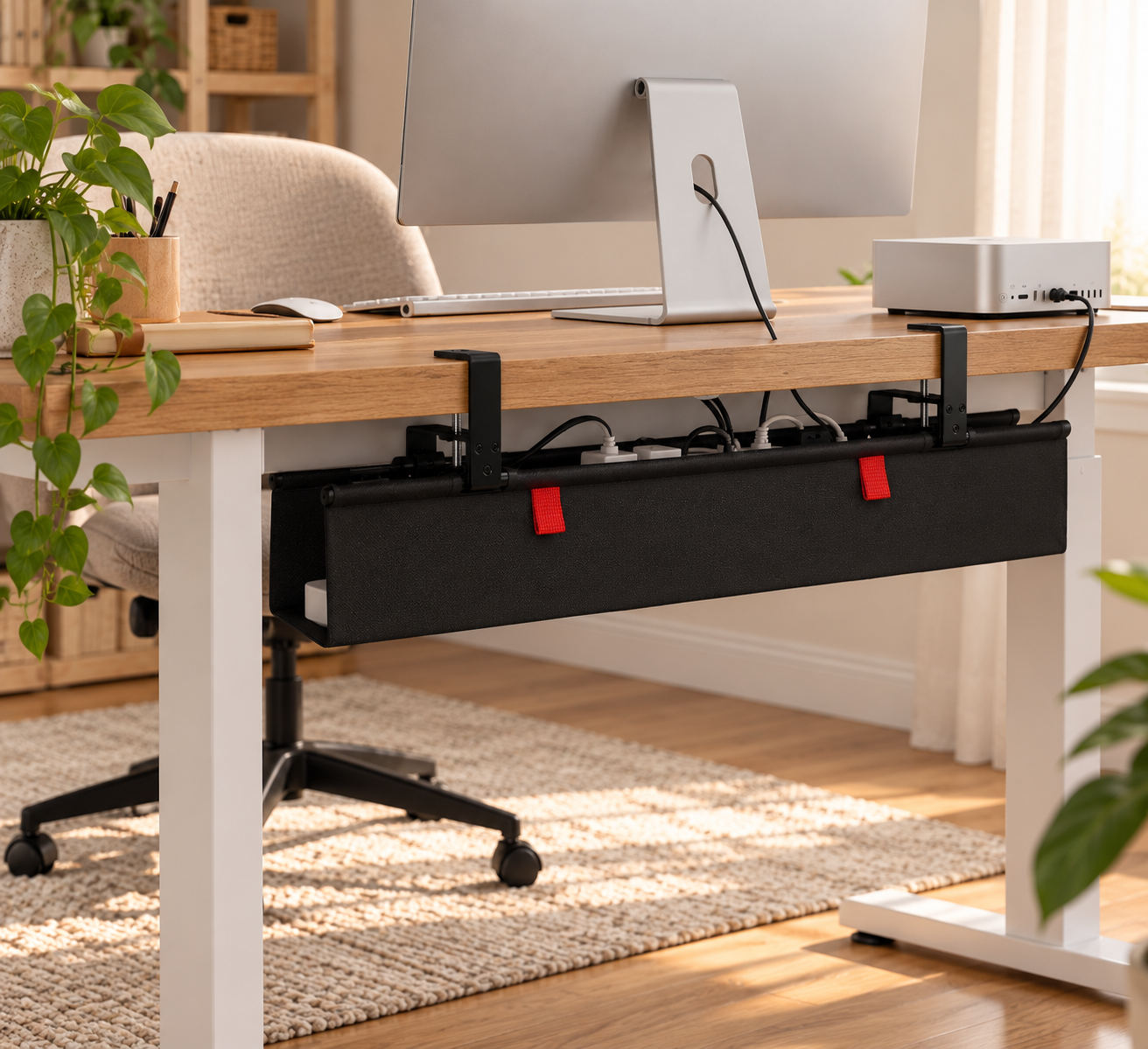
A few practical points apply to any tray:
Leave some slack in every cable so you can still move the chair, adjust the monitor, or slide the desk slightly.
Keep the power strip reachable so you can switch it off or unplug things.
Check that the tray sits clear of your legs and any drawer track.
If you would rather not buy anything, the same idea works with adhesive cable clips or a simple cord tie, and it is worth doing before you buy anything larger.
Use Vertical Space Without Making the Office Feel Busy
Going up is the classic answer for small spaces, and it works, but only when it is done with restraint. Vertical storage that covers a whole wall tends to make a tiny office feel like a supply closet. A better approach is to choose one or two vertical zones and keep them calm.
Raise the screen, use what is beneath it
A monitor or laptop riser lifts the screen and creates a usable space underneath it. This is the most compact form of vertical storage on a desk, because the footprint stays the same while the space beneath becomes useful. A monitor stand riser with a storage drawer and two pen holders is an example of that idea, with the storage built into the riser rather than added as extra containers.
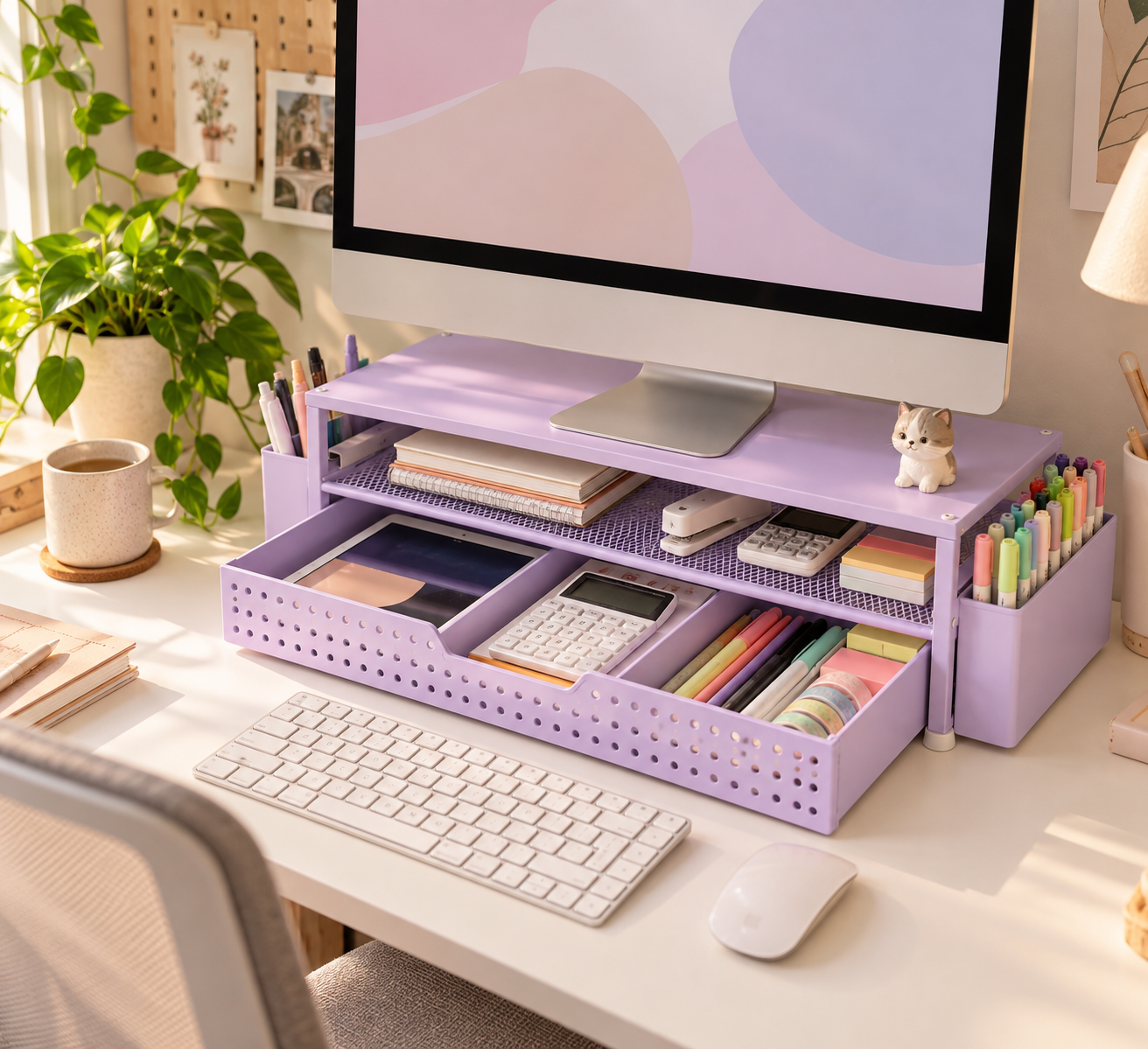

That is the real advantage in a small workspace: one piece can replace several separate desktop organizers. Fewer objects on the desk generally reads as tidier than many small tidy objects. Check that the riser's footprint fits your desk depth and that your screen sits at a comfortable height when raised.
Storage is only part of a functional setup. These practical office gadgets include other useful ways to make a workspace easier to use without adding unnecessary clutter.
Wall storage, kept simple
Walls are valuable in a tiny office, but the goal is to relocate things, not decorate with storage.
One shelf above the desk. A single shelf at a reachable height holds reference books or a small box of supplies. Two or three shelves stacked tightly often feel heavy.
A pegboard or grid panel. Useful if you hold many small tools, such as craft or creative supplies. It works best in a limited area rather than across the whole wall.
Wall-mounted file holders. Vertical files take up almost no floor and keep paperwork visible and sorted.
Adhesive or removable hooks. Suitable for lightweight items in a rental. Check the weight rating and your wall surface first.
If you rent, check your lease before drilling. Freestanding, over-the-door, or adhesive solutions are safer starting points.


Vertical files and slim shelving
Paper is one of the hardest things to store in tiny spaces. Filing items upright, in a narrow holder rather than stacked flat, makes them easier to find and takes less surface. If your paper is mostly reference, scanning it and keeping only originals you legally need can reduce it further.
Keeping vertical storage from feeling cluttered
Limit visible storage to one or two categories, such as books and one box.
Use matching containers or a small set of colors.
Leave some empty wall or shelf space on purpose.
Put closed storage (boxes, drawers) at eye level and open storage lower or higher.


Move Storage Off the Desktop
If the desk itself is overloaded, the answer is often to relocate items to somewhere you can still reach easily. The question is how close each item needs to be.
Options for the area beside the desk include a slim shelf or narrow bookcase, a small chest of drawers that doubles as a nightstand or side table, a bench with storage, a bin under an existing console table, or a rolling cart.
Storage beside the desk works best when it holds occasional-use items. If you find yourself reaching for something ten times a day, it likely belongs closer.


When a Rolling Storage Cart Makes Sense
Movable storage suits changeable spaces. In a bedroom or living room office, a cart can sit next to the desk during work hours and roll away, into a closet or against another wall, when you need the room back.
A cart like this rolling storage cart with five drawers, pegboards, a wooden top, and bins can hold office supplies, notebooks, cables, paperwork, or creative materials in one place. The pegboard sides can hold lightweight tools and the top surface can act as a small landing spot.
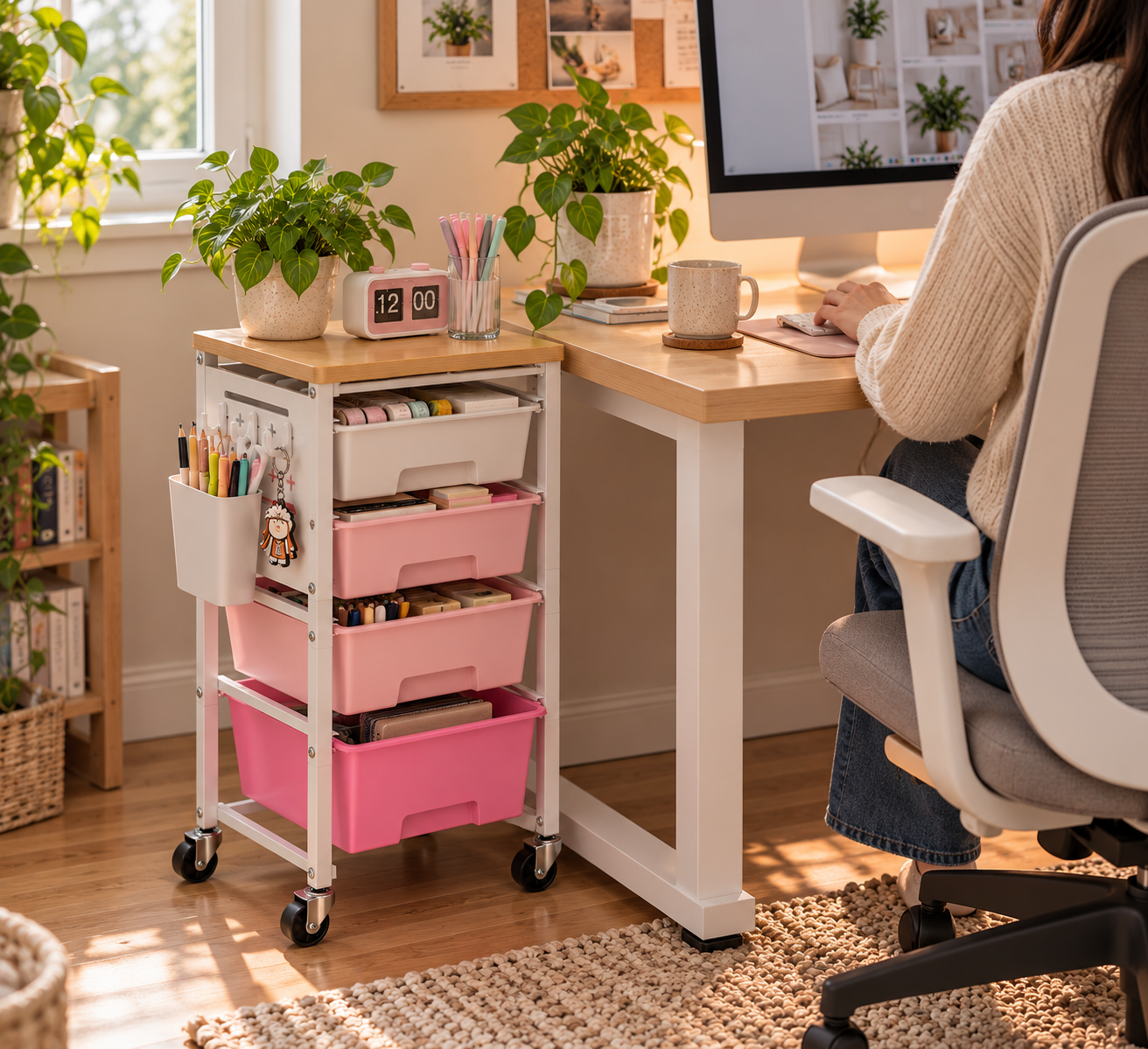
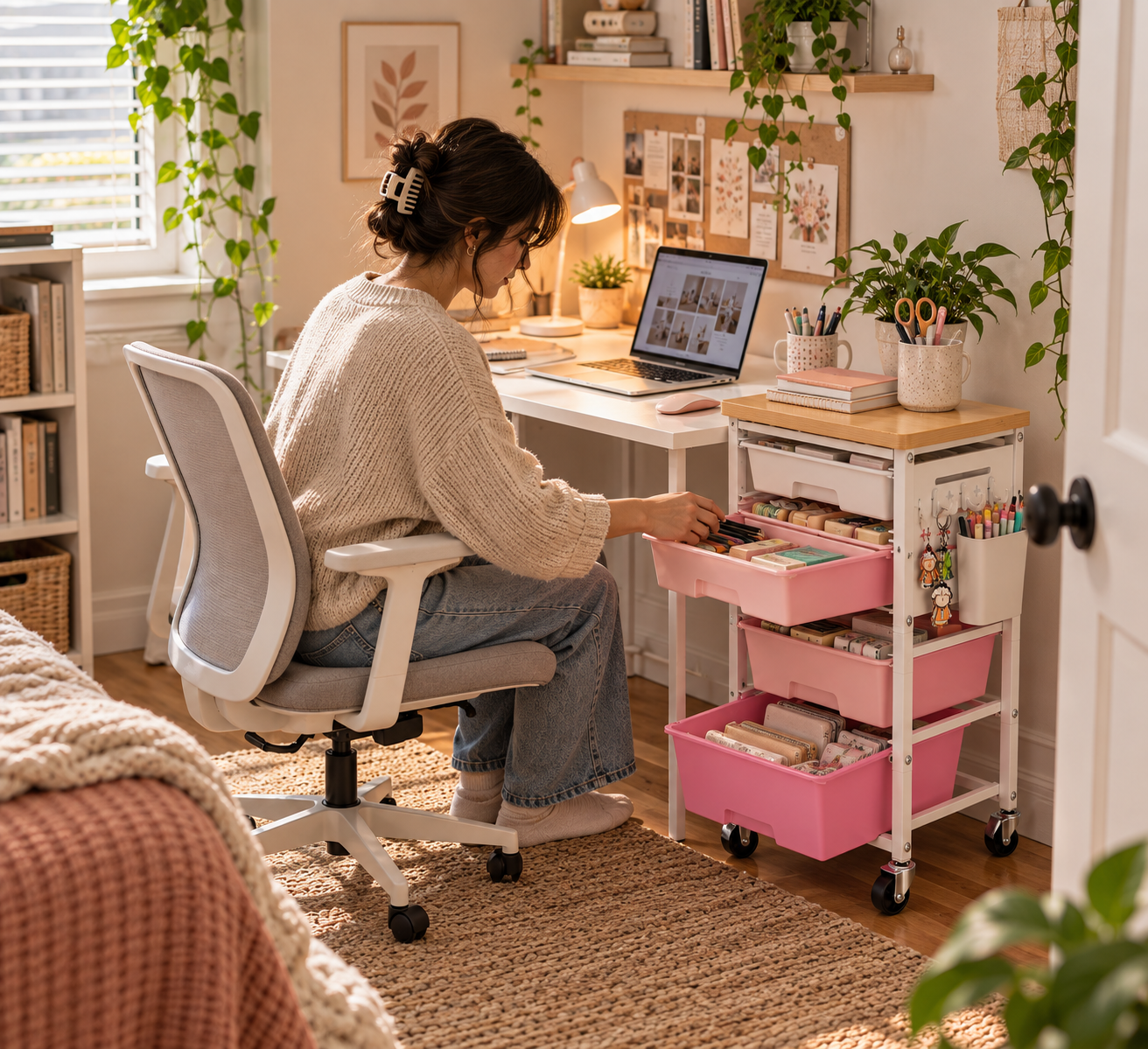
Where a cart works well:
There is a narrow unused strip beside the desk or in a nearby corner.
Your supplies vary, such as a mix of office and creative materials.
You need to clear the space at the end of the day.
Your desk has no built-in drawers.
Where a cart works poorly:
Floor clearance around the desk is already nearly zero.
The only space available is in the path of a door, a closet, or your chair.
You have a very small amount to store, in which case an under-desk drawer or a shelf may be enough.
A cart still occupies floor space. It is a relocation tool, not a way to create space from nothing. Measure the spot first, including the width the cart needs to roll out and the room to open drawers fully.
Make Each Item Do More Than One Job
In a tiny workspace, every object should earn its footprint. A few examples of pieces that do double duty:
A monitor riser with storage provides screen height and a place for small supplies.
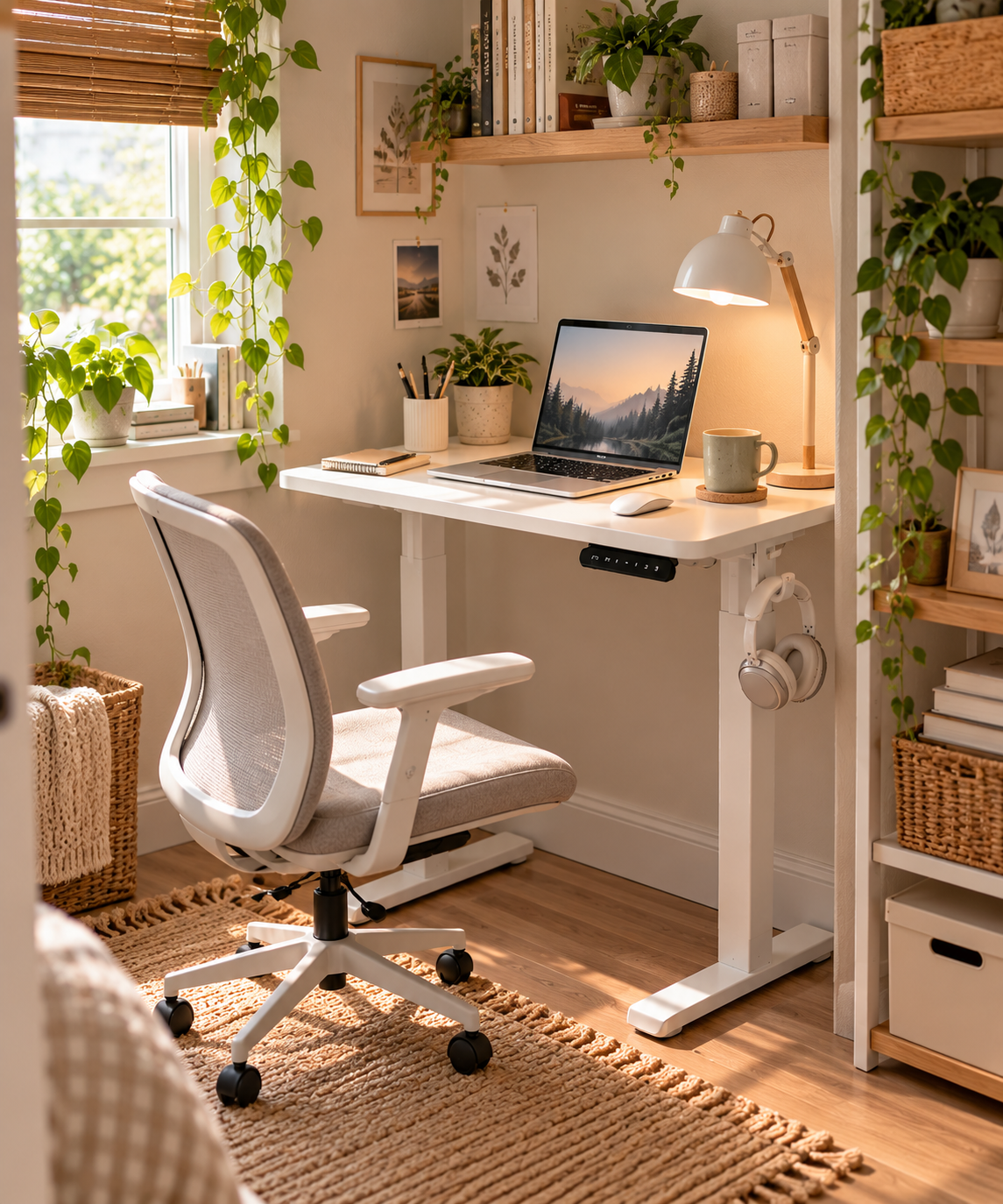
A desk with a compact footprint can leave more room in the layout. If you are setting up a tiny office from scratch or working with a very oversized desk, a 35 x 20 inch electric height-adjustable desk is one compact option to consider. If your current desk already fits the room, keeping it is usually the more economical choice, and a smaller desk is not always necessary.
A storage bench or ottoman provides seating and hides supplies.
A dresser or console can function as a desk in a bedroom and hold items in its drawers.
A pegboard or shelf can double as wall decor when styled with restraint.
Before adding a multifunctional piece, ask what it replaces. If it does not replace something you already have, it is probably just one more item.
If storage is only one part of the problem, these office must-haves focus on practical upgrades for comfort, charging, organization, and everyday productivity.
Free Up Desk Space by Changing How Accessories Are Mounted
A surprising amount of desktop space is taken up by objects that could be attached to something else. A lamp base, a phone stand, a tablet holder, and a headphone stand each take a small footprint that adds up.
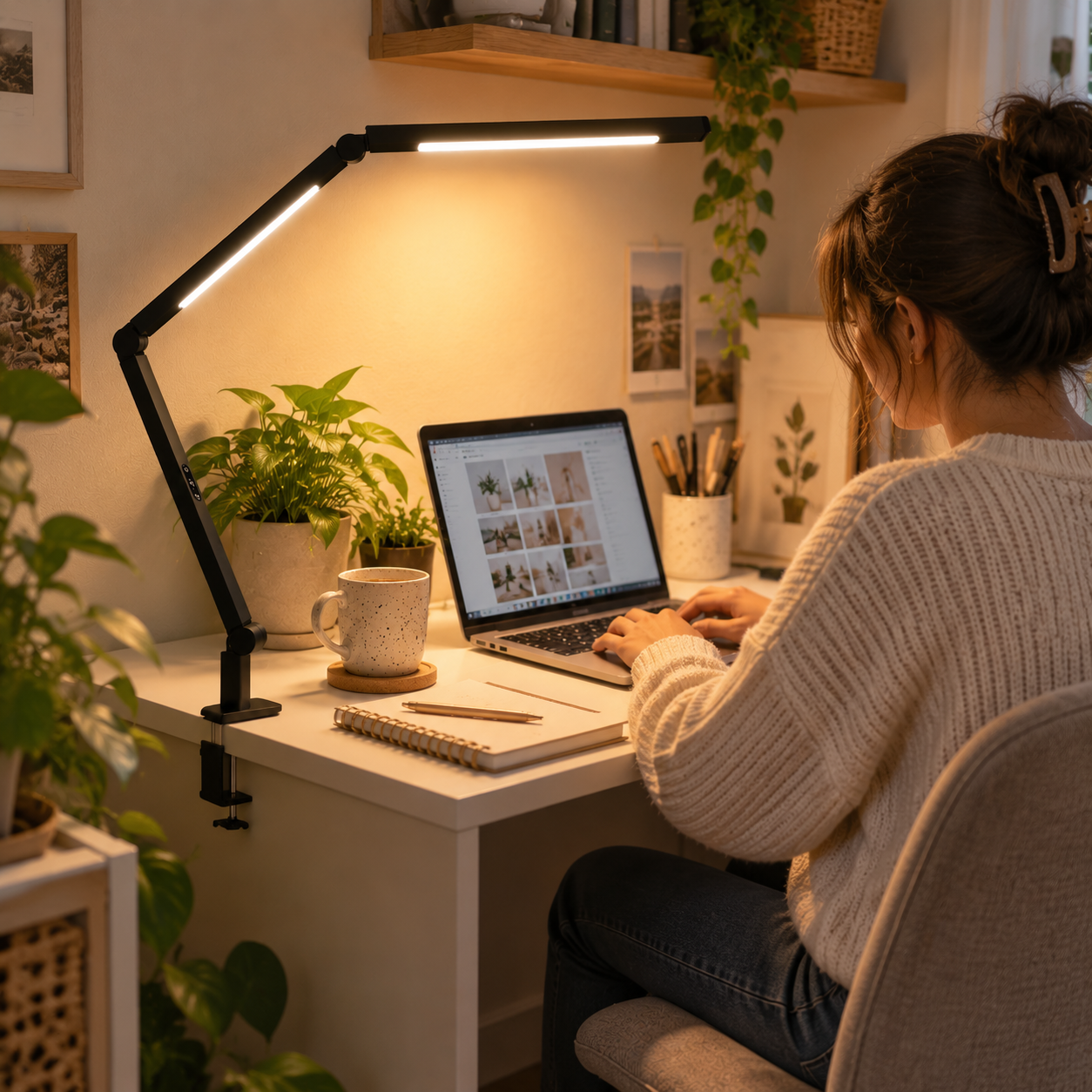
A clamp lamp is a simple example. By attaching to the edge of the desk, it removes the base from the working surface. A clamp-style LED desk lamp with an adjustable swing arm and dual light is one option, and the listing mentions multiple lighting modes and brightness settings. Before choosing any clamp lamp, check that your desk edge has room to clamp, that nothing underneath blocks the clamp, and that the arm can reach where you need it.
Other ways to lift items off the surface include a wall-mounted or shelf-mounted light, a hook on the side of the desk for headphones, a monitor arm, and a small tray under the monitor for tools you use often.

Small Office Storage Ideas for a Desk Without Drawers
Many small desks, particularly simple tables and console-style desks, have no drawers at all. This is one of the most common tiny-office problems, and there are several ways to handle it.
Create a drawer with an under-desk drawer. A clamp-on or mounted drawer, such as the one mentioned above, adds shallow storage without a new piece of furniture.
Use a rolling cart or a small chest of drawers next to the desk.
Choose a single desktop organizer with compartments, rather than several loose containers. A riser with a drawer serves this purpose.
Store items in a nearby closet or shelf and bring out only what you need for the day.
Use a wall shelf above or beside the desk for books and boxes.
Try a lidded box under the desk for paper and supplies, if legroom permits.
For a rental, favor solutions that clamp, sit on the floor, or use removable adhesive where appropriate
Small Office Storage for a Bedroom or Apartment
If your office is a corner of another room, your storage has to respect the room's main function. The workspace should not overwhelm the rest of the space, and it should be easy to tidy at the end of the day.
Some approaches that suit apartments and bedrooms:
Choose closed storage. Boxes, drawers, and cabinet doors keep work items out of sight when you are off duty.
Use furniture you already need. A dresser, nightstand, or bookshelf can hold supplies without adding a piece.
Make the workspace easy to close. A cart that rolls into a closet, a drop-front desk, or a screen can separate work from rest.
Use the wall behind the desk for a shelf or file holder, keeping the sightline uncluttered.
Store a portable setup. If you work on a laptop, a lidded box or a small bag can hold cables and supplies so everything moves in one trip.
Keep renter rules in mind. Prefer freestanding or removable options unless you have permission to drill.
If you are furnishing a first place, our small apartment ideas may help you plan the rest of the room around this workspace.
No-Buy Small Office Storage Ideas
Before purchasing anything, try these. Many tiny offices need less storage than they think.
Reduce duplicates. Multiple pens, tape rolls, and notepads are common. Keep a working set and store the rest elsewhere.
Relocate rarely used supplies to a closet, a shelf in another room, or under a bed.
Reuse containers you already own, such as shoe boxes, jars, mugs, and food storage containers.
Go digital where appropriate. Scan reference papers and keep only the originals that matter. Check what you need to keep for legal or tax reasons first.
Rearrange the furniture. Turning the desk to face a different wall, or moving it beside a window or closet, can open up floor space and change what is possible.
Group items by how often you use them. Daily items stay within arm's reach and everything else moves further away.
Use an existing closet or cabinet for supplies, even a single shelf.
Clear a drawer in another room for office overflow.
If one of these works, there is no need to buy anything for that problem.
What to Measure Before Buying Office Storage
Measure before you shop and write the numbers down. Most returns and frustrations in small offices come from a piece that is a few inches off.
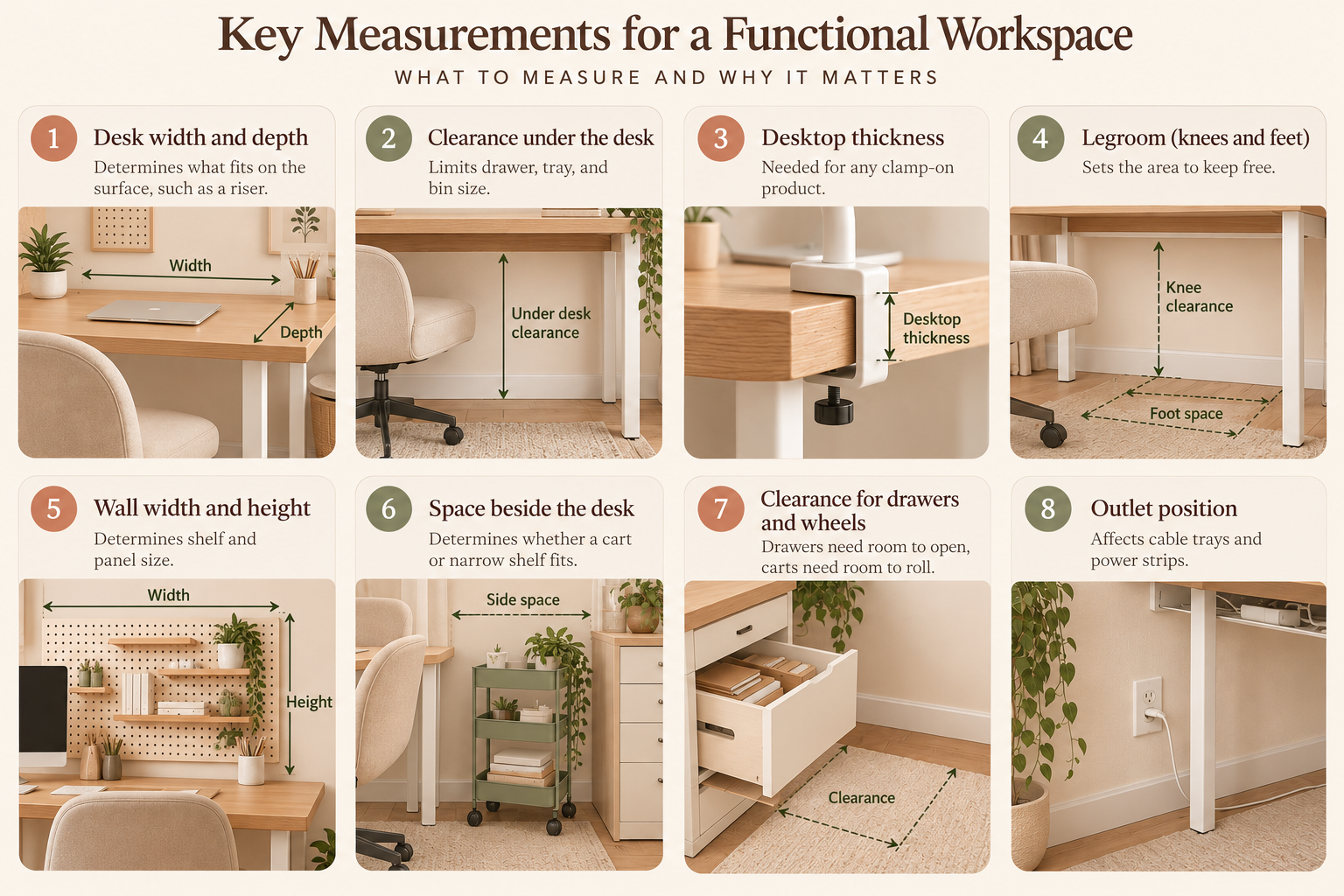
Also measure the path to the desk. A piece that fits the corner but blocks a door or a chair swing will not work in practice.
Small Office Storage Mistakes to Avoid
Buying organizers before decluttering. Storage for items you do not need is wasted space.
Filling every inch. A tiny office needs some open space to feel usable.
Blocking legroom. Comfort matters more than an extra drawer.
Adding many small containers. A lot of little boxes can look busier than one larger, well-chosen piece.
Keeping rarely used supplies on the desk. Move them out of prime space.
Buying furniture without measuring. A few inches can make a piece unusable.
Ignoring cable access. You still need to reach outlets and plugs.
Choosing storage that makes daily items hard to reach. If you avoid using it, it is in the wrong place.
Which Solution Fits Your Workspace?
A quick way to choose, based on the space you have:
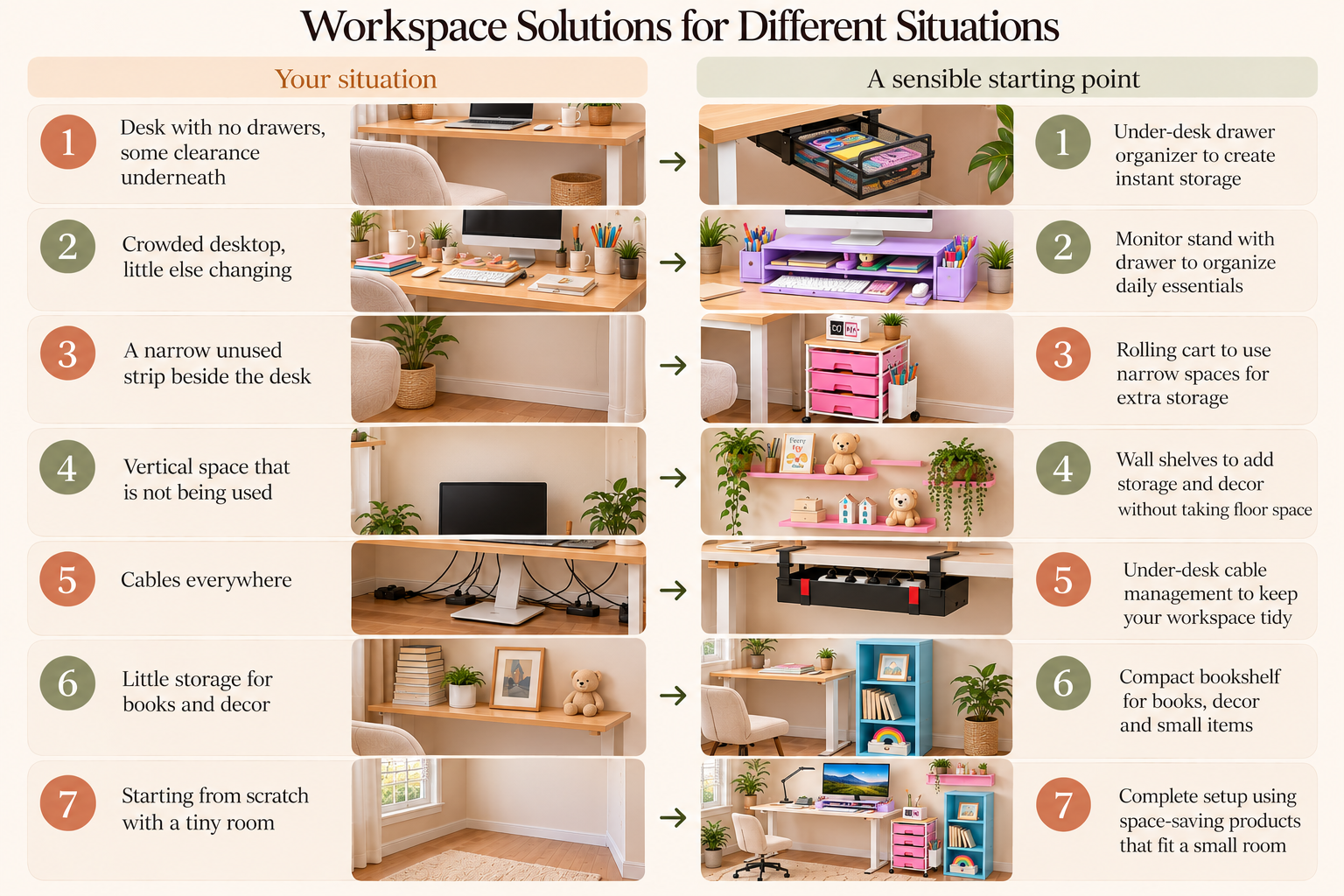
Start with the sorting exercise and the no-buy options. Then add one piece at a time, measuring first, and see how the space feels before adding another.
