
A small laundry room has to handle more than the machines themselves. Detergent, stain treatments, dirty clothes, clean clothes, hang-dry items, ironing or steaming supplies and a few household extras can all end up competing for the same limited space. These small laundry room ideas start from a different place than “add more shelves and containers.”
Useful changes often begin with keeping the appliance area accessible, deciding what truly needs to live in the laundry space, using vertical space carefully, creating clear zones for dirty, clean and in-process laundry, and keeping everyday supplies easy to reach. This guide covers storage, folding, drying, laundry closets, stacked washer/dryer setups and everyday organization, with a focus on using what you already have.
Start With the Laundry Workflow, Not the Storage
Organization works better when the room supports the actual sequence of laundry:
Dirty laundry enters the space.
It is sorted, if you sort.
Clothes are washed.
Clothes are dried or hung.
Clean clothes are folded or put on hangers.
Clothes leave the laundry room.
Before moving anything, notice where that sequence currently breaks down. Maybe dirty clothes block the floor. Maybe detergent is hard to reach, or clean clothes pile up on the machines. Maybe hang-dry items have nowhere to go, folding happens somewhere inconvenient, or household supplies have crowded out the laundry supplies.
Each of those problems points to a different fix. Storage should support the workflow, not exist simply because there is an empty wall. Laundry areas also vary a lot: dedicated rooms, closets, hallway setups, kitchen-adjacent spaces, bathrooms with machines, stacked or side-by-side units, top-loaders and front-loaders, rentals and owned homes. Take what fits your space and skip what doesn’t.
17 Small Laundry Room Ideas for Better Storage and Function
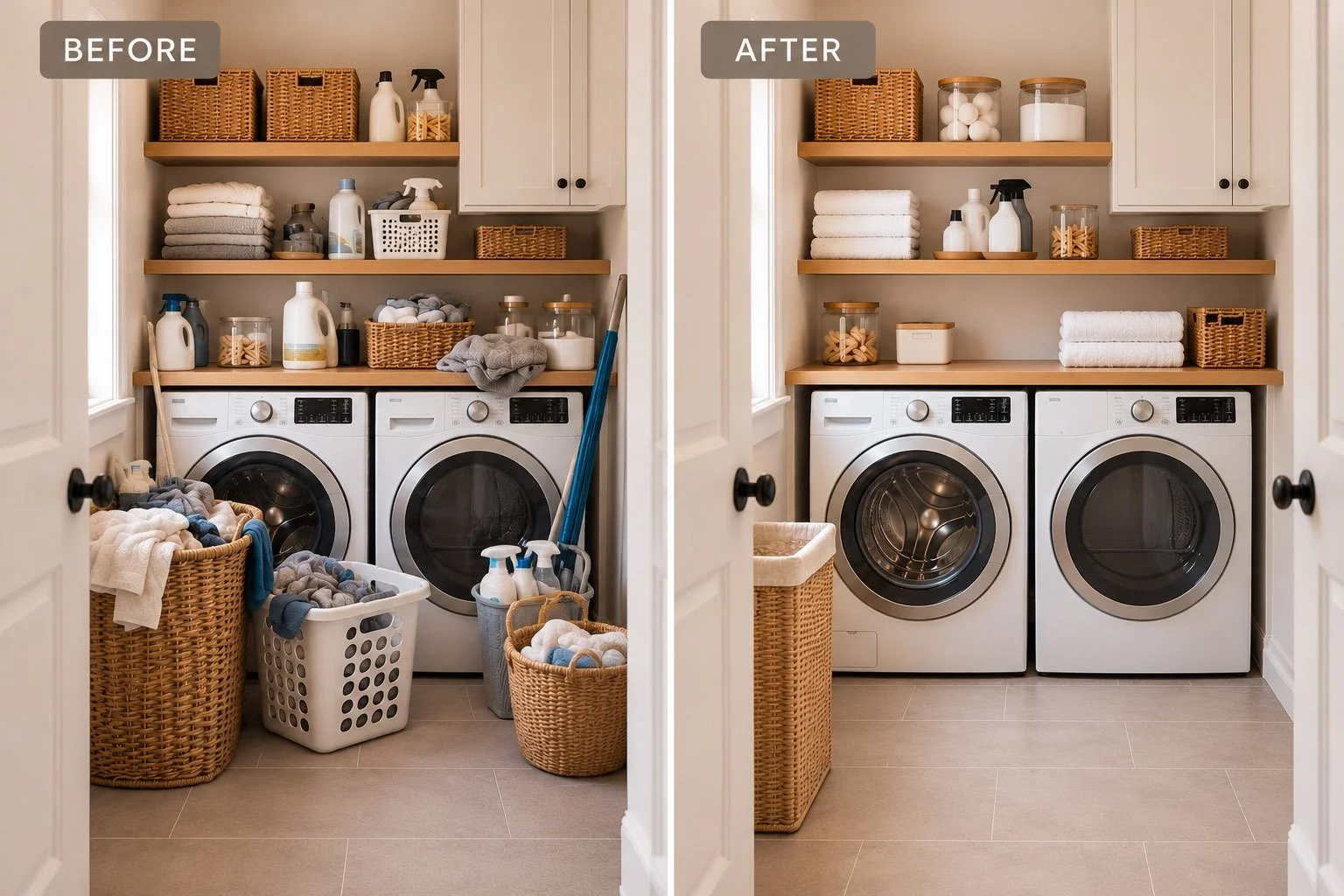
1. Keep the Floor as Clear as Possible
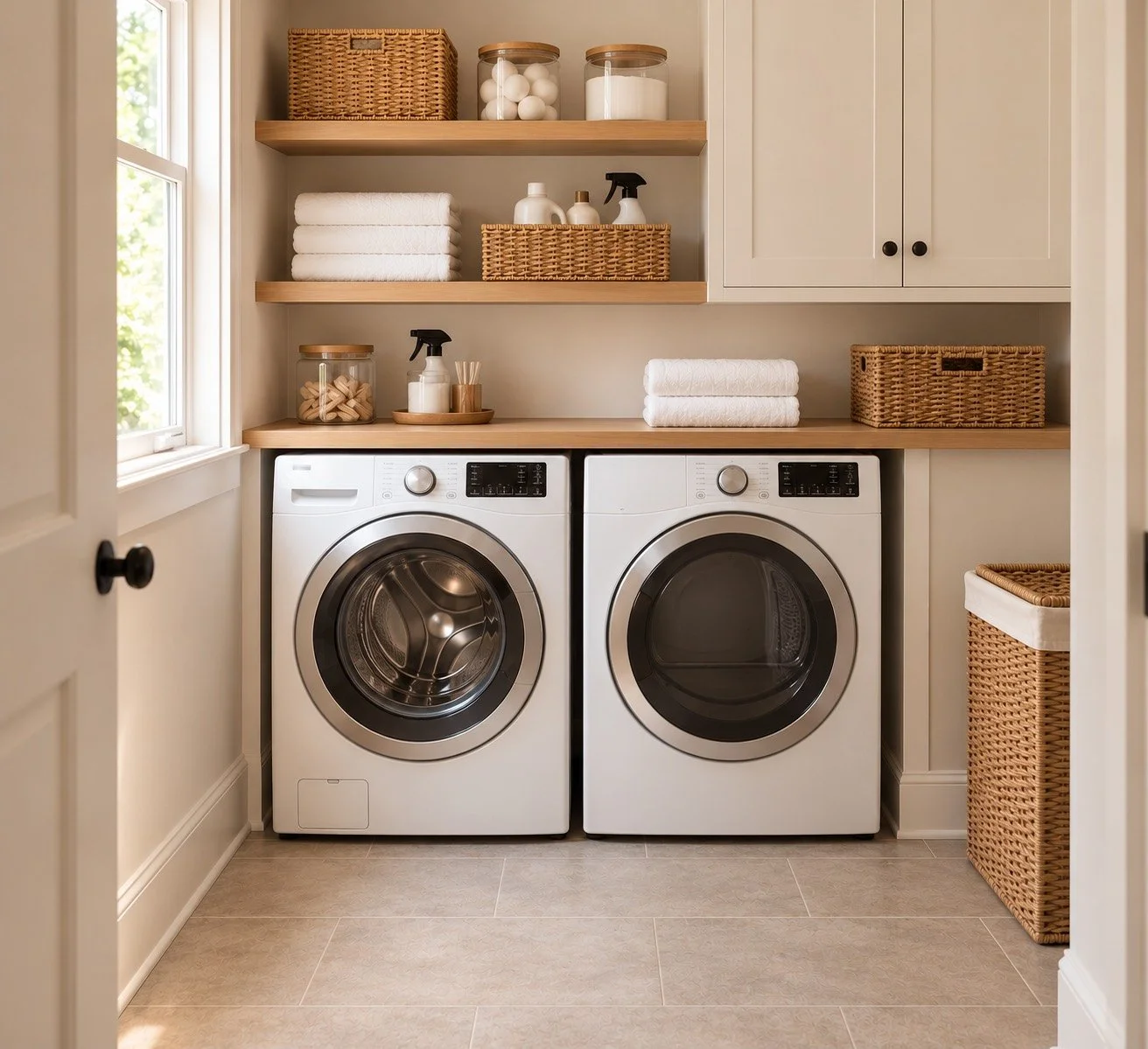
In a small laundry area, floor space is usually the most valuable thing you have. Hampers, baskets, extra bins, stools and stored household items can quietly fill it, and each one seems reasonable on its own.
Look at anything that permanently sits in the walkway and ask whether it earns that spot. Appliance doors need room to open, and you need room to load and unload comfortably, bending and reaching without shuffling things aside. There is no universal clearance number that works for every room, so judge by how the space feels when you do a load. If you have to move something every time, that item is a candidate for a new home.
The exception is a floor item that makes the whole process work, such as a single hamper that is genuinely used every wash day. That one can stay.
2. Keep Everyday Laundry Supplies Within Easy Reach
The products you reach for every wash should be the easiest to grab: detergent, stain treatment, dryer-related supplies if you use them, and a few basic cleaning cloths. Think about where you stand when you use each item. If you load the washer and then walk across the room for stain remover, the layout is working against you.
A good test is frequency. What you use weekly belongs at an easy reach level near the machines. What you use a few times a year does not need the same spot. This works in any layout, though in a very tight space “easy reach” may simply mean one shelf or one corner kept for daily supplies.
3. Move Backup Supplies Out of Prime Storage
Bulk refills and duplicates rarely need the most convenient shelf. A second bottle of detergent or a spare pack of cloths can live on a higher shelf, in a nearby utility closet or in another storage area of the home, if that is practical for you.
The aim is that prime laundry storage supports everyday laundry tasks, not stockpiles. The tradeoff is that you need to remember to restock from the backup location, and some homes have no secondary space at all. If that is your situation, keep backups to a small amount and let that limit guide how much you buy.
4. Use the Space Above the Machines Carefully
The wall above the machines is where many small laundry room storage ideas begin, and it can be useful. Existing shelving, cabinets or wall storage that is already safely in place can hold things you reach for less often than daily supplies.
It only works if the area stays accessible and suits your appliance setup. Avoid storing anything where it interferes with a top-loading washer lid, appliance hookups, ventilation or the ability to service the machines. This guide does not suggest specific shelf heights, because they depend on your machines and your room. Follow your appliance manufacturer’s instructions, and if you are unsure about mounting anything on a wall, ask a qualified professional.
5. Give Dirty Laundry a Defined Landing Zone
Dirty laundry spreads when it is unclear where it is supposed to go. A single hamper can solve that. Divided sorting areas only make sense if your household really sorts before washing, because otherwise they are extra containers to manage.
Dirty clothes also do not have to live in the laundry room at all. In a very small space, hampers may work better in bedrooms, with laundry carried in on wash day. That keeps the floor open and moves the clutter to where the clothes are taken off. If you are thinking through where hampers and clothing storage fit elsewhere, our guide to small bedroom storage ideas covers that side of the question.
6. Create a Temporary Zone for Clean Laundry
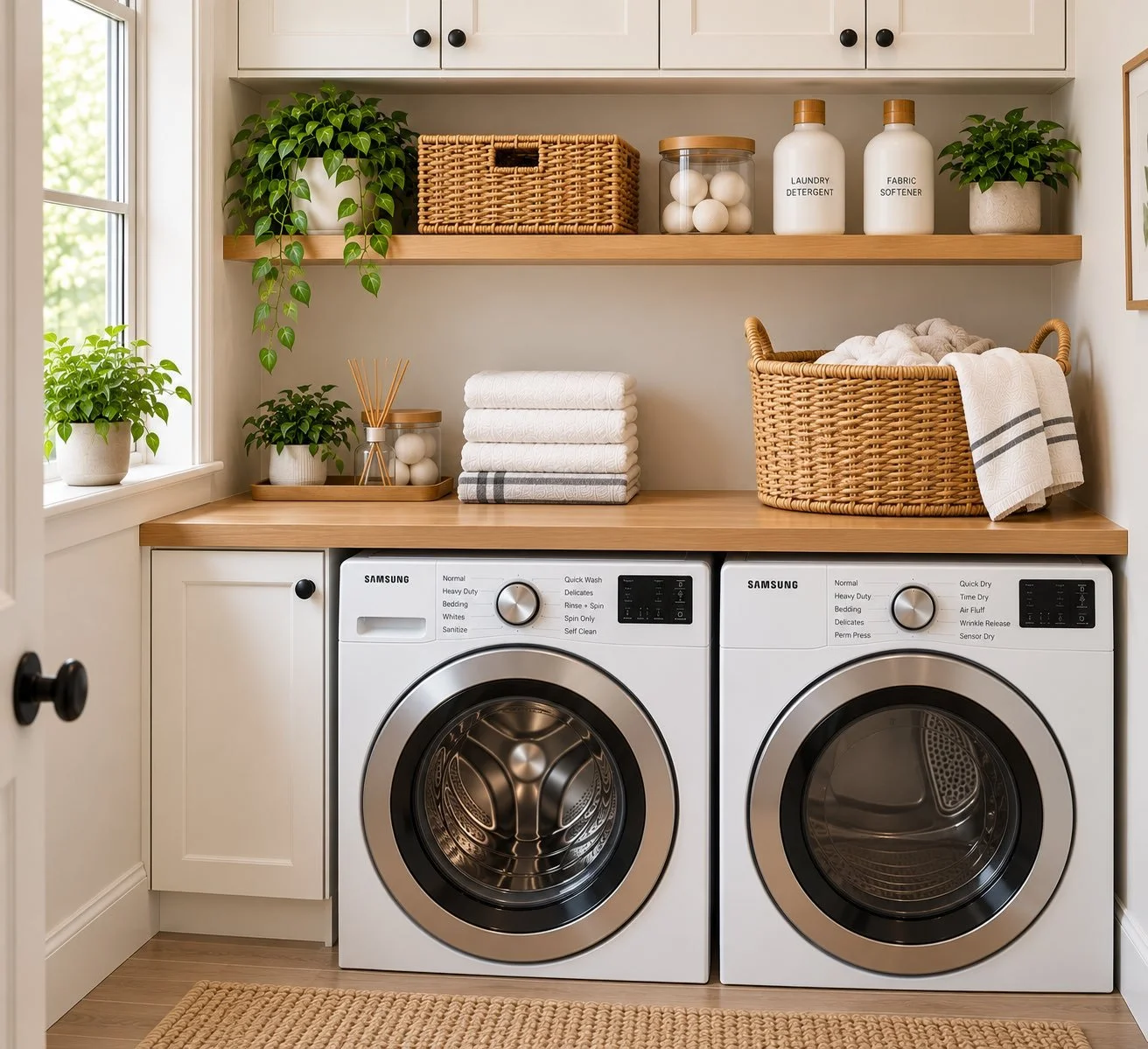
Clean clothes can easily end up piling on top of the machines when there is no clear place for them to go next. The fix is to decide where clean laundry waits, and for how long.
Some options: one defined surface, one basket that leaves the room as soon as the load is done, or folding right away somewhere else if that is more practical. The goal is that clean laundry never becomes permanent storage in the laundry room. If the pile keeps coming back, the problem is often the next step in the routine, such as no good place to fold or put things away, rather than the landing zone itself.
7. Use Vertical Space Without Covering Every Wall
Shelves, cabinets, wall hooks, hanging bars and existing tall storage can all help a tight room. But vertical space is not automatically better when there is more of it. Storage should not interfere with appliance doors, vents, switches, utility access or walking space.
A wall full of shelving can make a small room feel heavier and harder to use. Choose the one or two areas where vertical storage solves a real problem, such as hooks for a few frequently used items, and leave the rest of the wall alone. This is the same principle we talk about in our small living room ideas: protect circulation first, then add storage where it earns its place.
8. Create a Folding Surface Only If You Will Actually Use It
A folding surface helps when it matches your routine. Possible existing options include a countertop already above front-loading machines, a nearby counter, or a table outside the room. The top of a machine may work in some cases, but only if that is appropriate and safe for your appliance and how you use it.
Don’t place heavy or unstable items on appliances. If your household already folds on the bed or the sofa, a permanent folding station in a tiny room may just become another place for things to collect. Fold where you already naturally fold, and make that step easier.
9. Give Hang-Dry Clothes a Specific Place
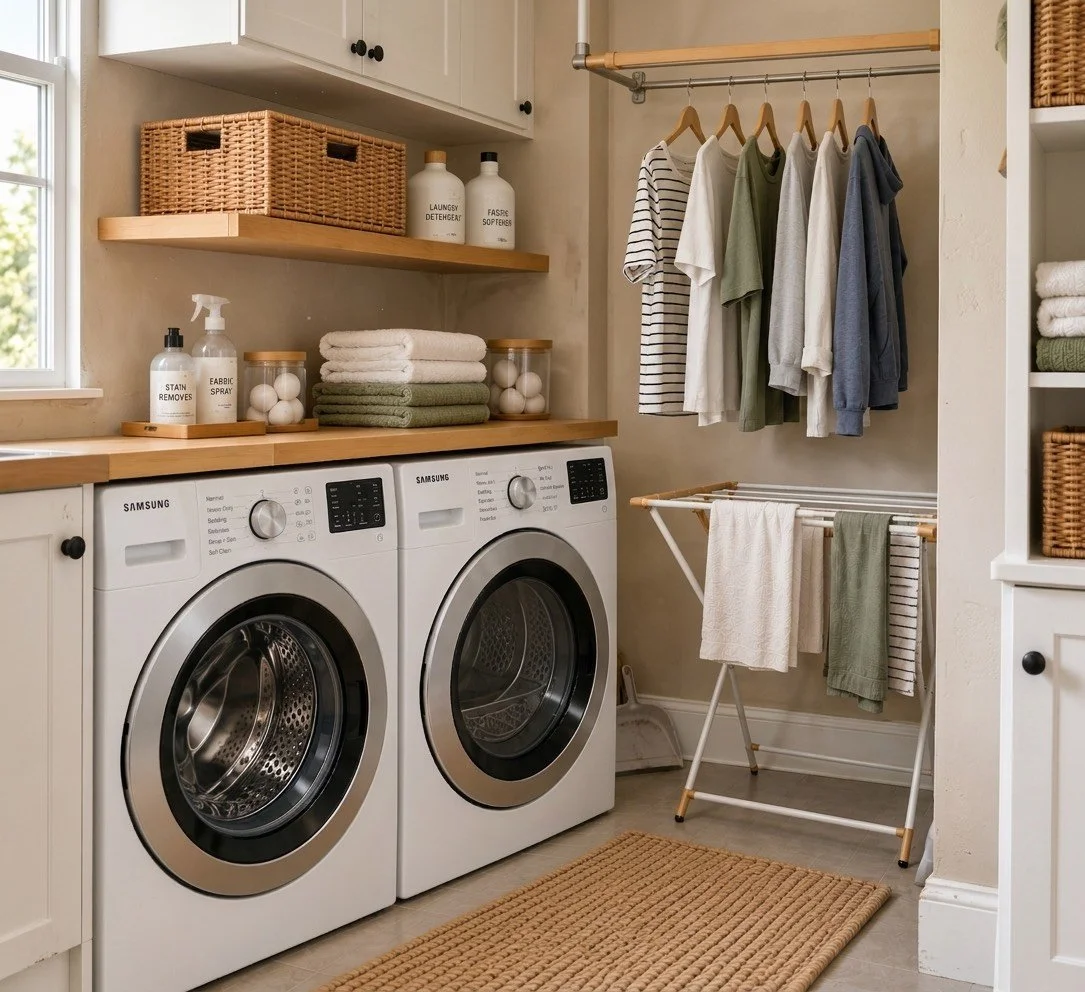
Hang-dry items need somewhere to go, but the laundry room doesn’t have to be that place. Options include an existing hanging rod, a wall or ceiling drying solution where appropriate, a bathroom rod, the shower area or another room.
If the space is too small to hang things safely, moving drying elsewhere may be the best choice. Do not hang wet clothing where it blocks appliances or creates an unsafe situation. The point is that wet items have a decided location, so they don’t end up draped over whatever is nearby.
10. Keep Household Cleaning Supplies Separate From Laundry Supplies
Many laundry spaces also become utility storage. Cleaners, tools, paper products and laundry products can all end up on the same shelf, which makes a tiny room harder to use because you have to search through unrelated things to find what you need.
Group items by purpose and relocate unrelated things when you can. Use common sense when storing cleaning products, and follow the instructions on their labels. A shelf dedicated to laundry products can make the supplies you use most often easier to find.
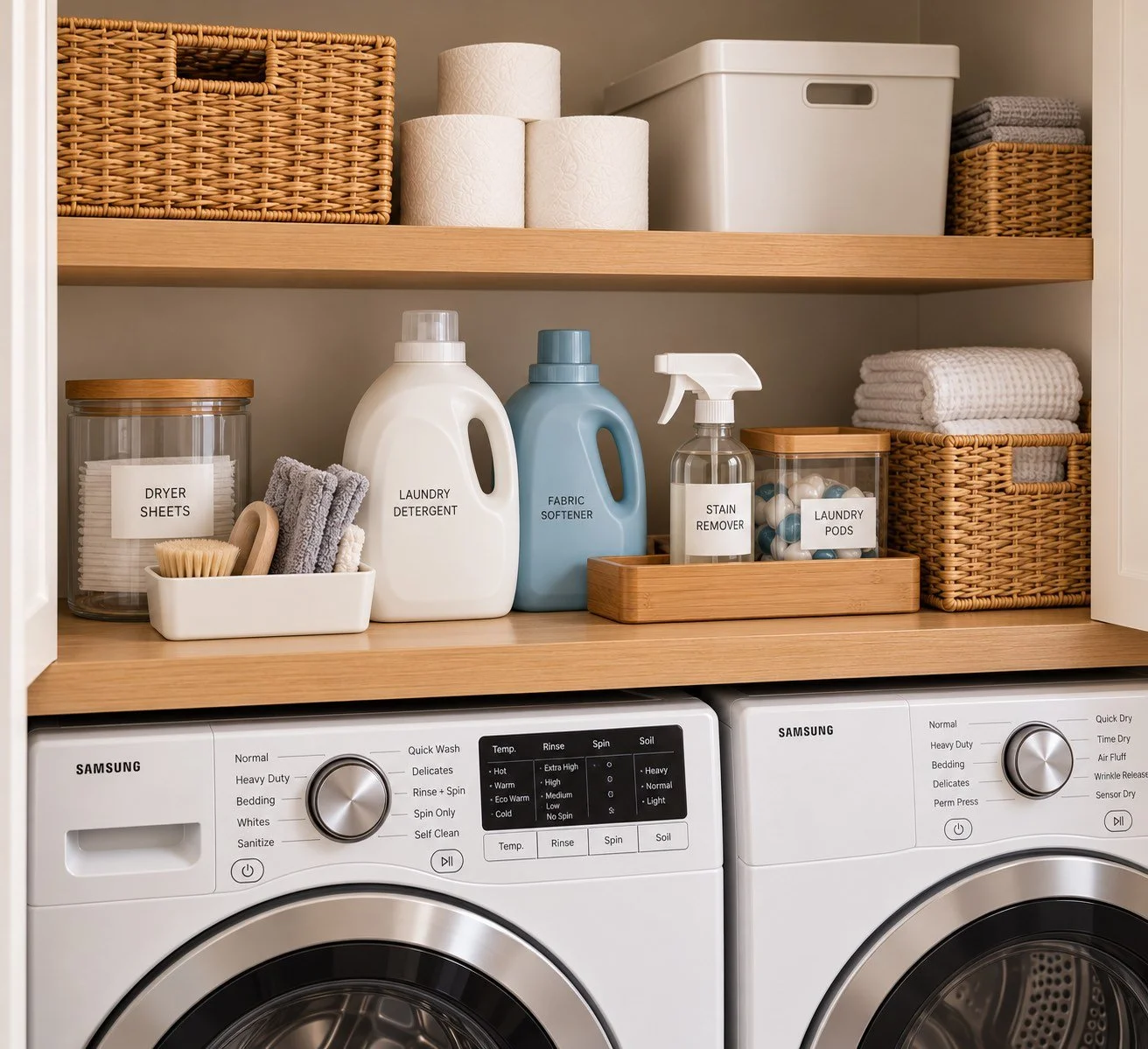
11. Use Closed Storage Where Visual Clutter Builds Up
Bottles, packages and miscellaneous supplies can make a small space feel busy even when it is technically tidy. Closed cabinets or existing drawers can help if you already have them, and it is worth using them for the items that look messiest.
This is not a reason to buy anything. Reducing how many supplies are visible can have the same effect, for example by finishing partial bottles, discarding empty packaging and keeping only what you use on display.
12. Make Open Shelves Easy to Maintain
If you have open shelves, they stay manageable when similar items are grouped together, frequently used items sit lower and within easy reach, and backups sit higher. Avoid building rows of matching decorative containers that create extra work to refill and keep tidy.
Keep products in their original packaging unless the manufacturer’s guidance explicitly says otherwise. Moving detergent or household chemicals into unlabeled containers can cause confusion and isn’t necessary for a system that works. Grouping and accessibility do most of the job.

13. Work With a Laundry Closet Instead of Treating It Like a Full Room
Good laundry closet ideas begin with accepting that a closet has limited volume. Think about the doors, how much ventilation the closet has, how easily you can reach the machines, and whether storage above or beside them makes sense in practice.
A laundry closet works best when it is focused mainly on laundry. Fewer extra items mean less to move when you need to get at the machines. Don’t remove doors or change ventilation without considering professional advice and, if you rent, your lease. Those changes can affect how the appliances work and what you are responsible for.
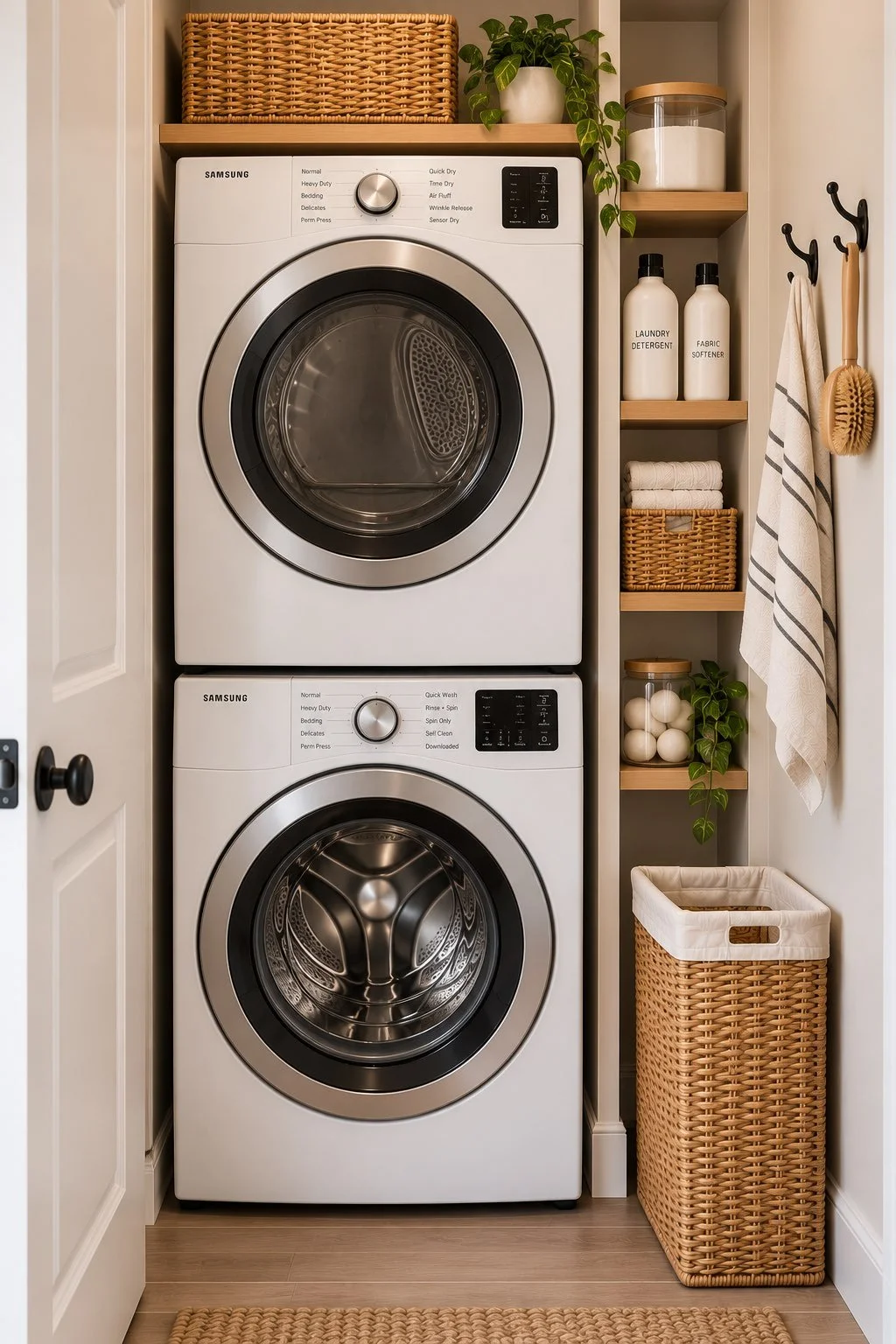
14. Make a Stacked Washer and Dryer Setup Work Vertically
Stacked washer dryer laundry room ideas often focus on the floor width you gain. Stacking can free some floor space but may create other constraints, such as reaching controls and getting to the machines for servicing. Only use a stacked configuration if the manufacturer specifically supports it. This guide does not cover how to stack machines.
Narrow wall space beside the machines can hold a few hooks, shallow storage where circulation allows it, or a small existing shelf. Whatever you add, controls must stay reachable and service areas accessible.
15. Keep Decor Secondary to Function
Laundry rooms can feel pleasant without being decorative showpieces. A piece of art, a coat of paint or a small decorative touch is often plenty. Decor should not take storage away from needed supplies or interfere with movement.
Not every laundry room needs to look styled. If yours simply works well, that is a good result.
16. Leave Room for Appliance Access and Maintenance
A neatly organized room doesn’t work if machine doors can’t open fully, shutoff points can’t be reached, vents are blocked, appliances can’t be serviced, or storage has to be taken apart each time you need access.
Keep these points in mind in general terms, and refer to your appliance instructions or a qualified professional for specific clearance and service requirements. Electrical, plumbing, gas and structural changes are jobs for qualified professionals, not DIY projects.
17. Remove One Storage Problem Before Adding Another Organizer
Before adding anything new, ask a few questions:
What specifically needs a home?
Does it need to stay in this room?
How often do I use it?
Will this storage make the laundry process easier?
Will it interfere with movement or machine access?
Relocating items or reducing duplicates can sometimes solve the problem better than adding another organizer. If the answers show a real gap, fill it. If they don’t, you may already have what you need.
Small Laundry Room Storage Ideas for Different Layouts
Side-by-Side Washer and Dryer
Side-by-side machines may leave a surface above them if they are front-loaders, and the wall above can sometimes hold storage. Keep machine doors accessible, and don’t assume every machine can safely support items on top. Check your appliance instructions. Avoid storage that crowds narrow aisles on either side.
Stacked Washer and Dryer
With stacked machines, use the side space rather than assuming you can store things above them. Keep the controls accessible, and use hooks or a narrow shelf to reduce floor clutter. Because stacked machines free up floor width, protect it by keeping loose baskets and bins out of that space.
Small Laundry Closet
Small laundry closet ideas come down to restraint. Keep supplies limited, use existing overhead storage efficiently, and work around the door so it still opens and closes freely. Make sure ventilation and appliance access are not compromised by anything you add.
Laundry Area in a Bathroom or Kitchen
When laundry shares a room with other functions, the main challenge is containment. Keep laundry supplies from spreading into the rest of the room, separate functions where you can, and use storage you already have. Closed cabinets or a dedicated shelf can help laundry items stay visually distinct from bathroom or kitchen items.
Rental Laundry Area
In a rental, avoid permanent structural changes, use existing shelving and storage first, and check your lease before drilling or modifying fixtures. Most of the ideas above, like clearing the floor, grouping supplies and relocating backups, require no changes to the space at all. For more ways to work with a rental, see our renter-friendly apartment ideas.
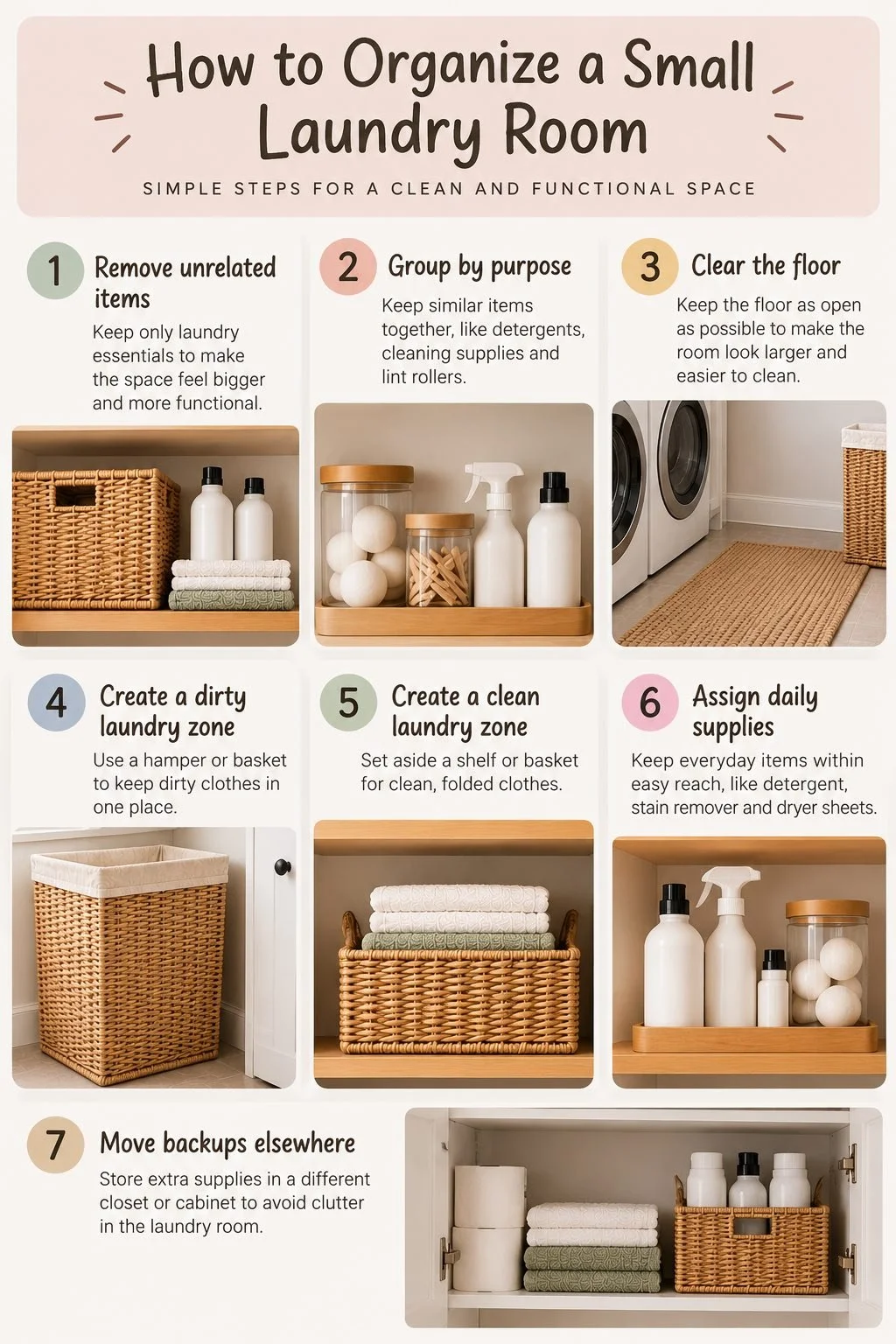
How to Organize a Small Laundry Room Step by Step
If you are wondering how to organize a small laundry room without a big project, this sequence works in a realistic order:
Remove items that do not belong in the laundry area. Take out anything unrelated, such as tools, spare household goods or things waiting to be put away elsewhere.
Group remaining items by purpose. Laundry products together, cleaning products together, and so on.
Identify daily-use supplies versus backups. Decide what you actually reach for each wash.
Clear the floor. Move anything that doesn’t need to be on it.
Establish where dirty laundry waits. One hamper, or hampers in bedrooms.
Establish where clean laundry waits temporarily. One surface or one basket.
Decide where hang-dry items go. Pick a specific place, in or outside the room.
Assign prime storage to frequently used supplies. Put the daily items where they are easiest to reach.
Move backups to secondary storage. Higher shelves or another area of the home.
Check that appliance doors, vents and service areas remain accessible. Open everything and make sure nothing is blocked.
Use the system before adding new organizers. Live with it for a few weeks and see what is still missing.
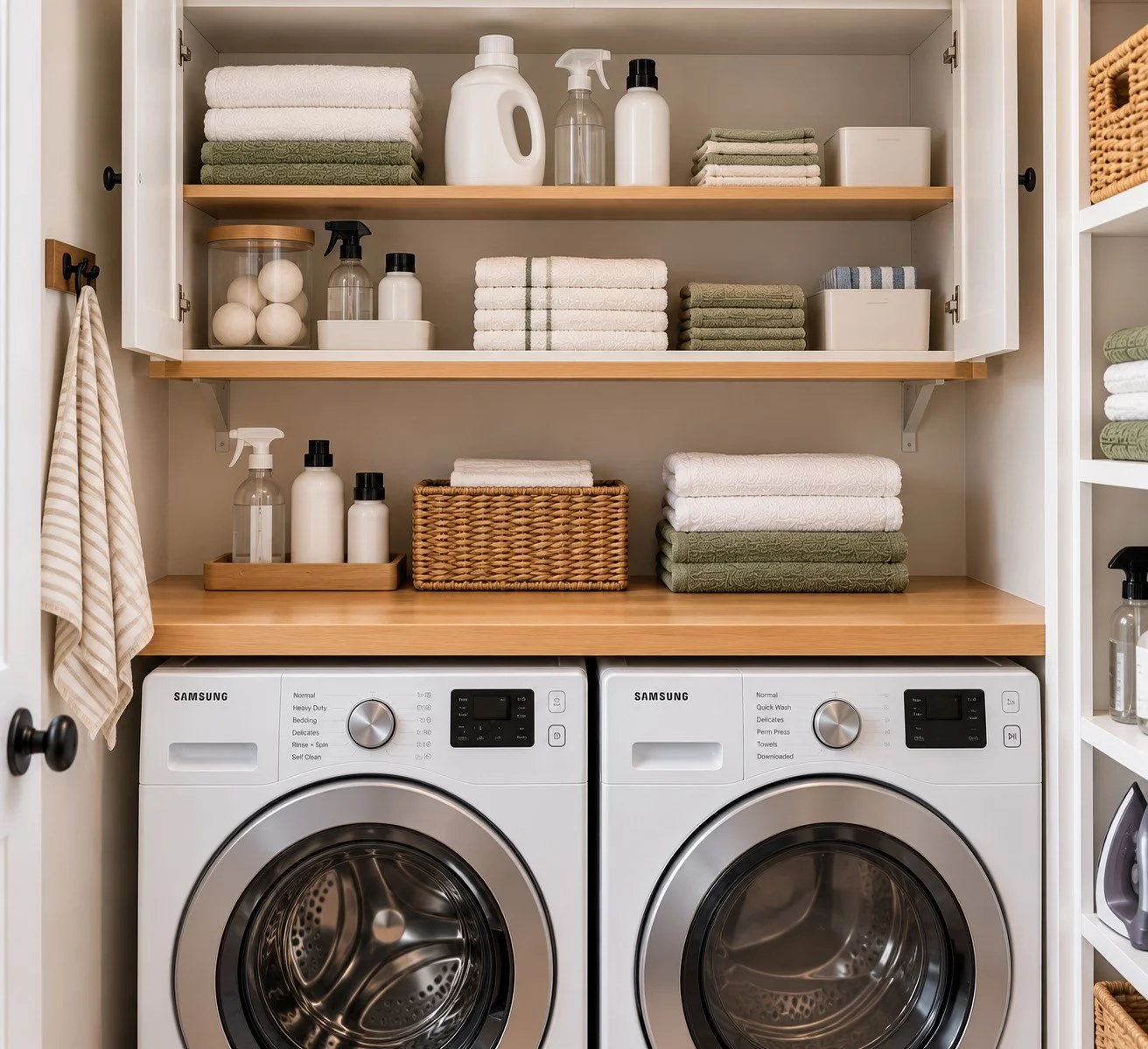
Laundry Room Organization Ideas You Can Try Without Buying Anything
Many laundry room organization ideas don’t need a single new product. Try these first:
Remove unrelated household items.
Move backup detergent to secondary storage.
Clear the tops of the appliances.
Consolidate laundry supplies into one zone.
Relocate hampers if they block the floor.
Use existing shelves according to how often things are used.
Remove empty packaging.
Return lost clothing and other items to the rooms where they belong.
Choose one clean-laundry landing zone.
Stop storing things in the laundry room just because there is an empty shelf.
This kind of small laundry room organization can solve the underlying clutter problem without adding another container, because it focuses first on what actually needs to stay in the space.
What Makes a Small Laundry Room Harder to Use?
If the room still feels difficult, one of these may be the cause. None of them is a failing. They are common in tight spaces.
Blocked floor space. Items in the walkway slow every load.
Appliance doors that can’t open freely. Anything that interferes with them makes the room harder to use.
Too many backup products. They take up the best storage.
Clean laundry stored permanently in the room. It crowds the surfaces you need.
Dirty laundry without a clear zone. It spreads wherever there is room.
Supplies stored far from where they are used. Extra steps add up.
Open shelves packed with unrelated items. It is hard to find what you need.
Storage blocking service access. This can create problems later.
No place for hang-dry clothes. Wet items end up wherever there is space.
Household storage that belongs elsewhere. The laundry room becomes a default storage space.
Identify which one or two apply to you, and start there.
A Simple Laundry Room Reset
A reset keeps things working without becoming a chore. Do it whenever the room starts to drift, perhaps once a week or after wash day:
Return clean clothes to bedrooms.
Gather stray laundry supplies.
Clear appliance surfaces.
Reset the dirty-laundry area.
Return cleaning items to their assigned zones.
Check that the floor and appliance access remain clear.
It should take a few minutes, not a deep clean.
A Small Laundry Room Works Better When the Laundry Process Comes First
The most useful starting point is the workflow, not the storage. Look at how laundry moves through the space, find where it gets stuck, and let that decide what the room needs. Everyday supplies deserve the prime spots, while backups and unrelated items can move elsewhere. Keep the floor and appliance access clear, and add storage only when it solves a specific problem. More organizers are not automatically better.
The best system is one your household can realistically maintain. If you would like more practical ideas, explore Lulonta’s other organization and small-space guides.
