
A small closet can feel full even when the amount of clothing is reasonable. Everyday pieces, seasonal items, shoes, bags and rarely worn clothes all end up competing for the same easy-to-reach space, so the things you use most get buried under the things you use least.
The most useful closet organization ideas do not start with more bins, shelves or organizers. They start with a few simple decisions: what deserves prime space, how items are grouped, what can move farther away, and how to keep the floor and shelves usable. Often the biggest improvement comes from reducing duplicate or forgotten items, not from adding storage.
This guide covers small closet organization for reach-in closets, small walk-in closets, clothes, shoes, bags and everyday storage. Most of the advice works with the closet you already have, and the goal is function, not a showroom look.
Start With What You Actually Reach For
Closet organization works best when it starts with how often you use things, not with how they look. Before moving anything, notice a few details:
What you wear every week
What you wear occasionally
What is seasonal
What you rarely reach for
What keeps falling or getting buried
Which categories are hard to get to
Which items take up prime space without earning it
That gives you three rough access levels to work with:
Easy reach: everyday items you use most weeks.
Secondary reach: occasional items you want available but not in the way.
Less convenient areas: seasonal or rarely used items.
The exact spots depend on your closet and on you. What matters is that the easiest-to-reach areas are reserved for the things you use most often. Everything else can sit one or two steps farther away without making your day harder.
15 Closet Organization Ideas for Better Everyday Storage
You do not need to try all of these. Pick the ones that match the problems your closet actually has.
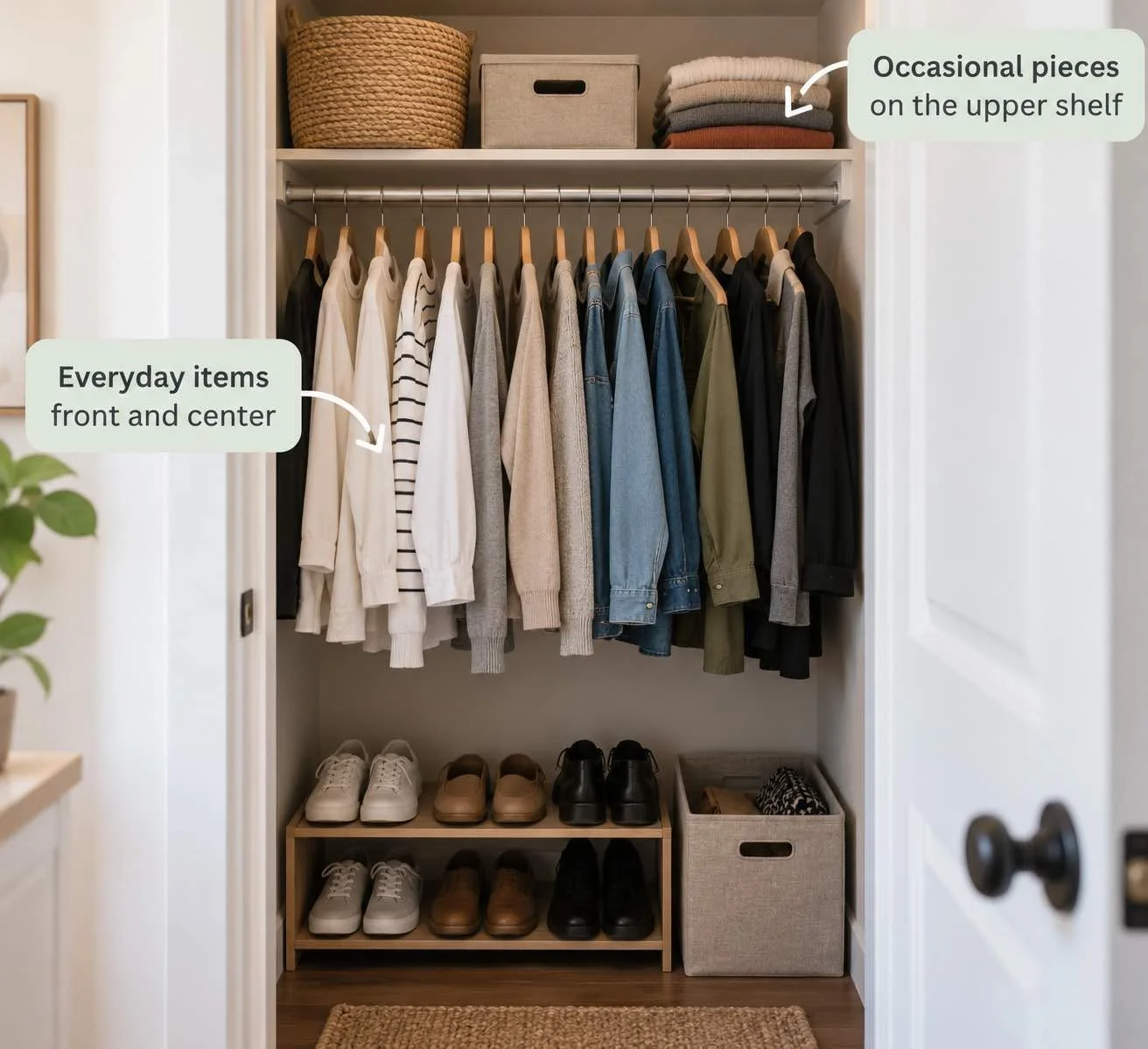
1. Keep Everyday Clothes in the Easiest-to-Reach Area
The clothes you wear every week deserve the easiest spot, because that is where your hand goes most often. Occasional pieces do not need the same access, and moving them out of the way means less searching, less pulling things out and less reshuffling a stack to find one item. The easiest area varies by closet: it might be the center of a reach-in, the section nearest the door, or the lower shelves on one side. Notice where you reach automatically and start there.
2. Group Clothes by How You Actually Use Them
Some people group by situation: work, casual, workout, outerwear, dresses, sleepwear. Others do better by clothing type, such as tops, pants and jackets. There is no single correct method, so choose categories that match your routine. If you dress for an office most days, keeping work clothes together saves time. If your week is mostly casual, sorting by type may be simpler. Try a grouping in your normal routine and adjust it if you keep hunting for things.
3. Move Seasonal Clothing Out of Prime Space
Heavy coats in warm months, summer clothes in winter, formalwear and holiday outfits all take up room you need for what you are wearing now. They can move to higher shelves, the less convenient end of the rod, or another storage area in your home if you have one. You do not have to store clothing outside the closet, since moving it to a harder-to-reach part is often enough. Just keep it findable so you are not hunting for it when the season changes.
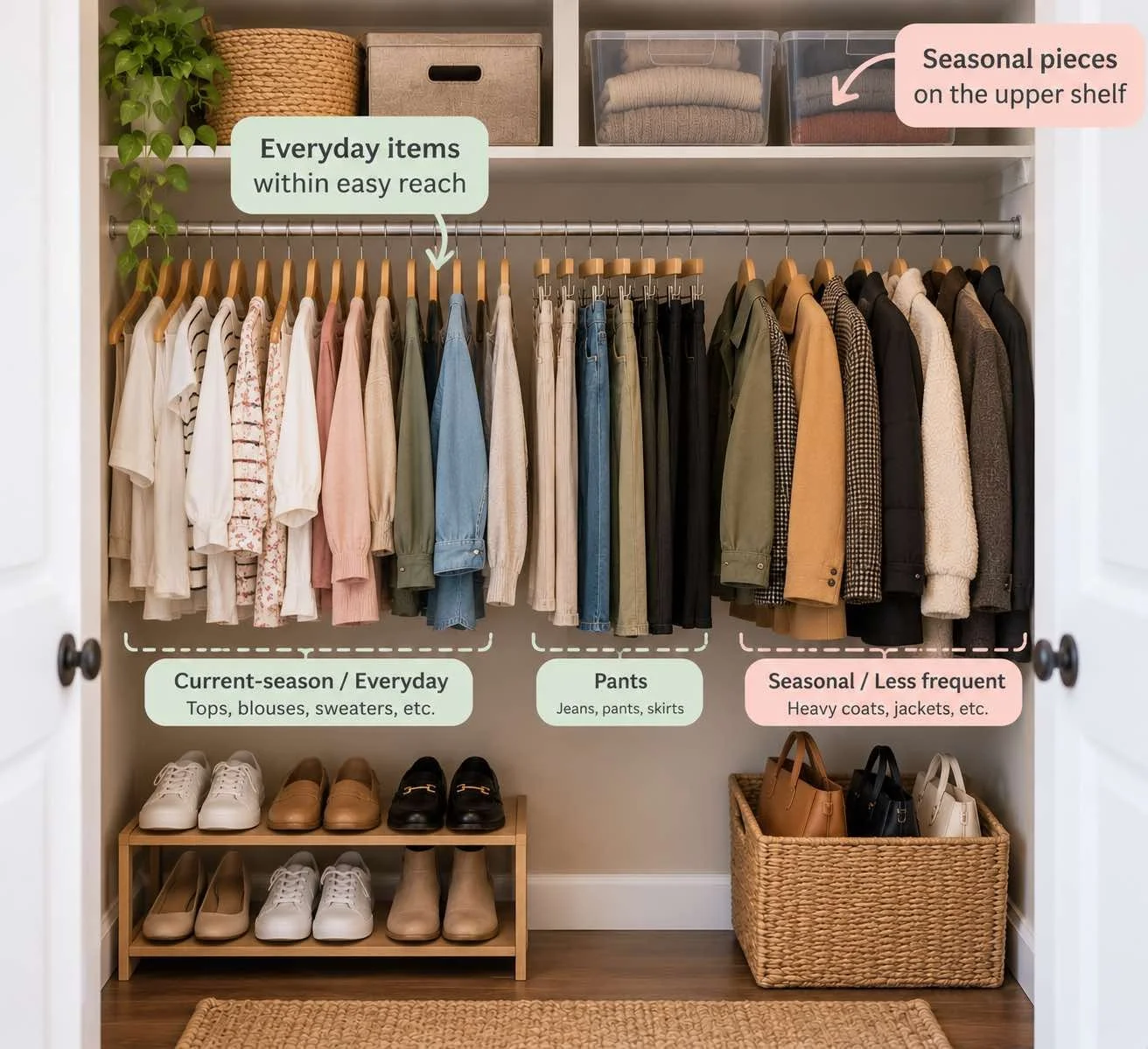
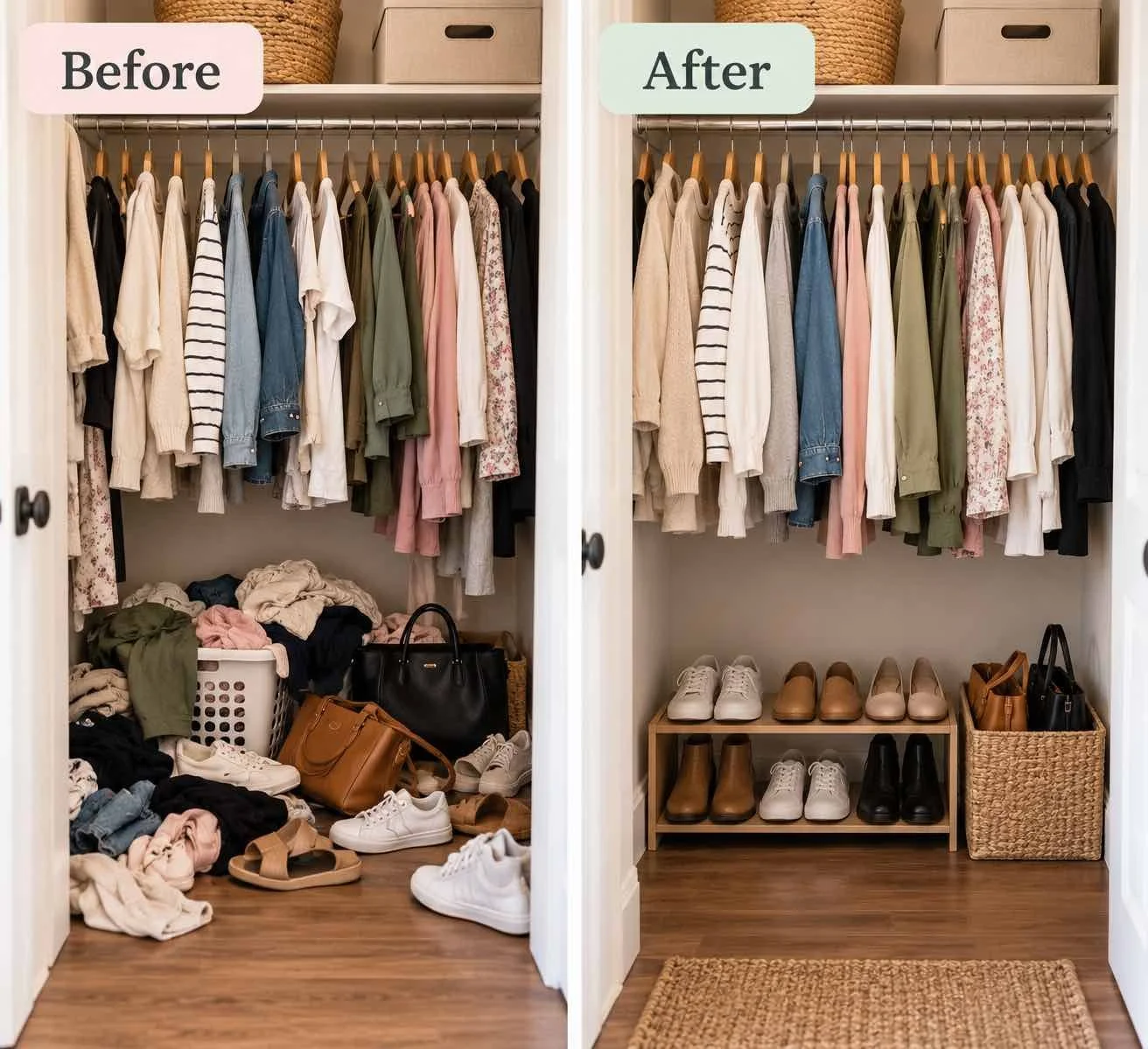
4. Protect the Closet Floor From Becoming a Drop Zone
A closet floor easily collects shoes, laundry, bags, boxes and things waiting to be put away. Floor space is easier to keep usable when it has a defined purpose, such as one area for everyday shoes with the rest left open. You do not need to cover the whole floor with organizers. A clearer floor makes lower items easier to reach and makes it obvious when something has drifted in that does not belong.
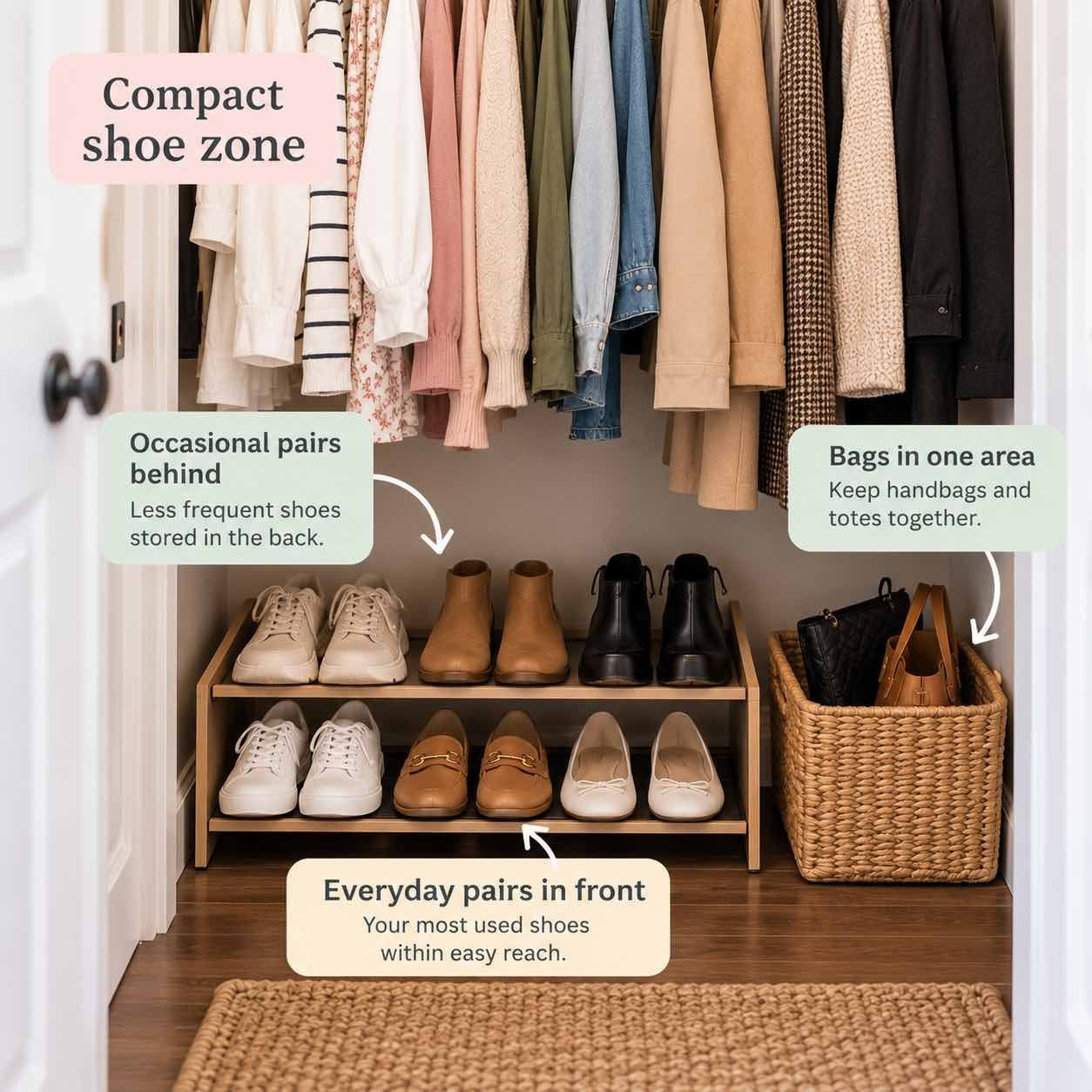
5. Give Shoes a Defined Zone
Shoes do not all need the easiest spot. Everyday pairs can stay within reach, occasional pairs can sit lower or farther back, and seasonal footwear can move to a less convenient area. Depending on your household habits, you may find everyday shoes work better by the entry than in the bedroom closet. The point is a defined zone, not a particular product: when shoes have a place, they stop spreading across the floor.
6. Store Bags So They Keep Their Shape and Stay Visible
Handbags, totes, backpacks and reusable bags keep their shape and stay easy to find when they have a spot of their own: a shelf, an upright group, or a hook that is already safely installed and sturdy. Group them by how often you carry them, with less-used bags higher or farther back. Avoid hanging heavy bags from weak hooks, thin rods or fixtures not meant to carry them. Nesting smaller bags inside larger ones saves space but hides the inner ones, so keep that for bags you rarely use.
7. Use Closet Shelves According to Frequency
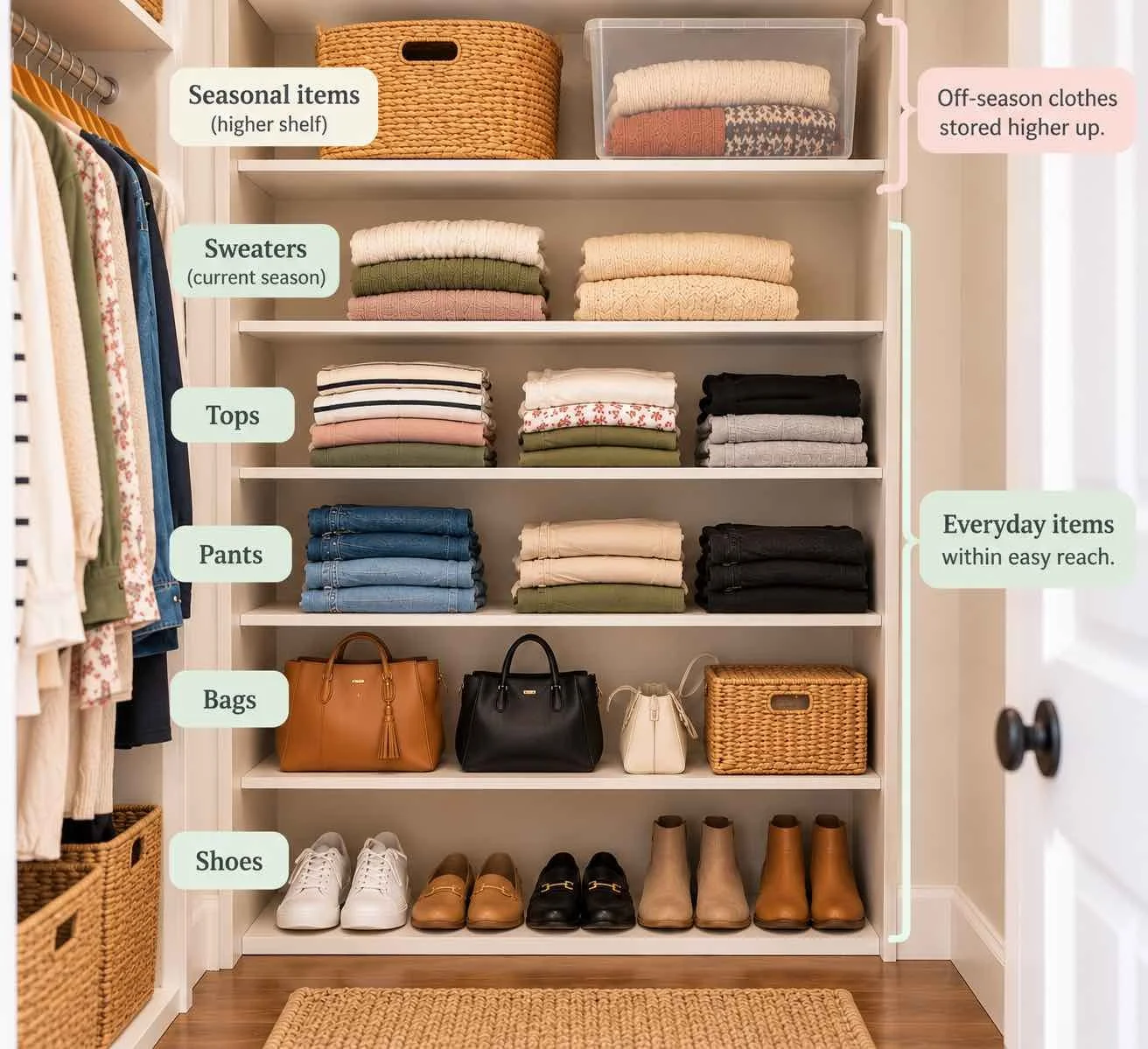
One of the simplest small closet storage ideas is to use shelves by how often you need what is on them: daily items lower and easier to reach, occasional items higher, and backups or seasonal items farthest away. Deep shelves are the tricky part, because things disappear behind other things. Try to avoid several rows of unrelated items; a visible front row with one related category behind it is easier to manage. High shelves are better suited to things you rarely need, while frequently used items should stay in areas you can reach comfortably and safely. If shelving is fixed or built in, confirm it can safely hold what you plan to put there.
8. Make Hanging Space Work Harder Without Overfilling It
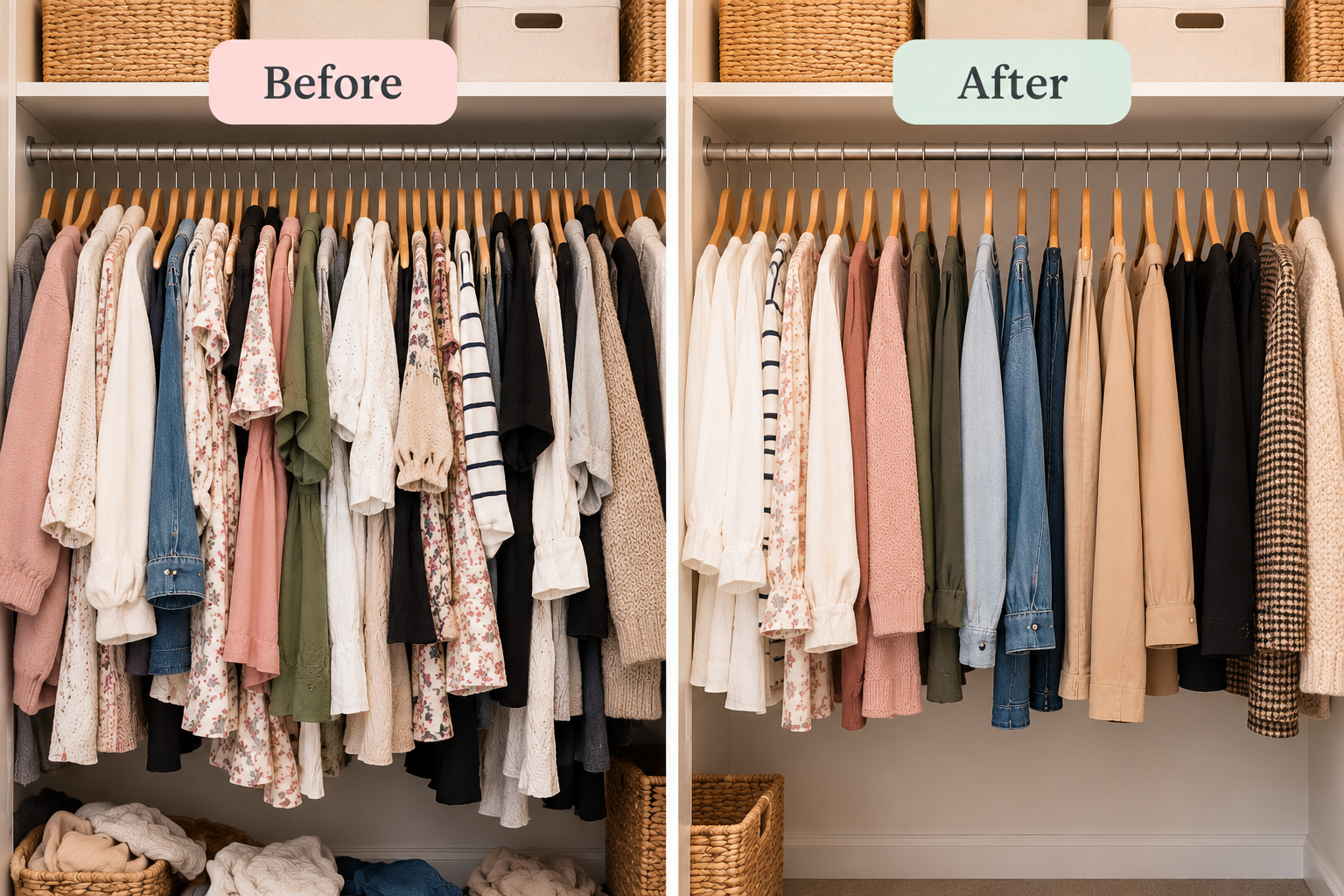
Hanging space works harder when it is easy to use, not just full. Remove empty hangers, group clothes of similar length so the space under shorter items is not wasted, and leave enough room for hangers to slide. Packing a rod tightly makes everything look the same and makes it harder to see what you own, so you end up wearing the same few pieces. Work with the rod as it is. A small gap between groups also shows you where one category ends.
9. Keep Small Accessories Together
Belts, scarves, hats, jewelry and smaller bags are easy to lose when they are scattered around a closet, and several tiny categories in different spots mean more searching. Gather them into one area using what you already have, such as a drawer, a small box or a basket. You do not need matching containers. Keep the accessories you use most in the most accessible spot, and check the box now and then, since a catch-all gets messy when it holds too much.
10. Keep Laundry From Becoming Closet Storage
Closets often end up holding clean clothes waiting to be folded, dirty clothes on the floor and a pile of worn-but-not-dirty pieces. Each is a normal part of life, and each needs a decided place that fits your routine, whether that is a hamper outside the closet, a hook or a basket. If a pile keeps returning to the same spot, that is useful information: your system may be asking for one more step than you want to take.
11. Use the Closet Door Only If It Solves a Real Problem
The back of a closet door can help, but only when it solves a specific problem. Hooks, lightweight accessories or over-door storage you already own may work for things you grab daily. The tradeoffs are real: items can stop the door from closing, make it heavy, get in the way when you reach in, or simply not work on a sliding door. If you rent, avoid drilling into the door and check your lease before any permanent change. For more ideas that leave no marks, see our guide to renter-friendly apartment ideas.
12. Reduce Duplicate Categories Before Adding Storage
Before adding anything, look at the categories that keep overflowing: tote bags, hoodies, jeans, shoes, scarves, even unused hangers. If a category keeps overflowing, it may be worth checking whether every item still needs to stay in active closet space. Some pieces may fit better in a secondary spot, and some may be things you have simply forgotten. This is not about getting rid of anything on a schedule. It is about knowing what each category holds so the best space goes to what you use.
13. Make a Small Reach-In Closet Easy to See
Most small reach in closet ideas come down to visibility, because a reach-in has a limited opening. Keep the center visible, place frequent items toward the front, and avoid stacks that block everything behind them. Upper shelves suit occasional pieces. Keep the floor from filling up too, since a crowded floor makes it hard to see past what is in front. In a narrow opening, being able to see everything at a glance matters more than fitting in one more item.
14. Let a Small Walk-In Closet Stay a Walk-In Closet
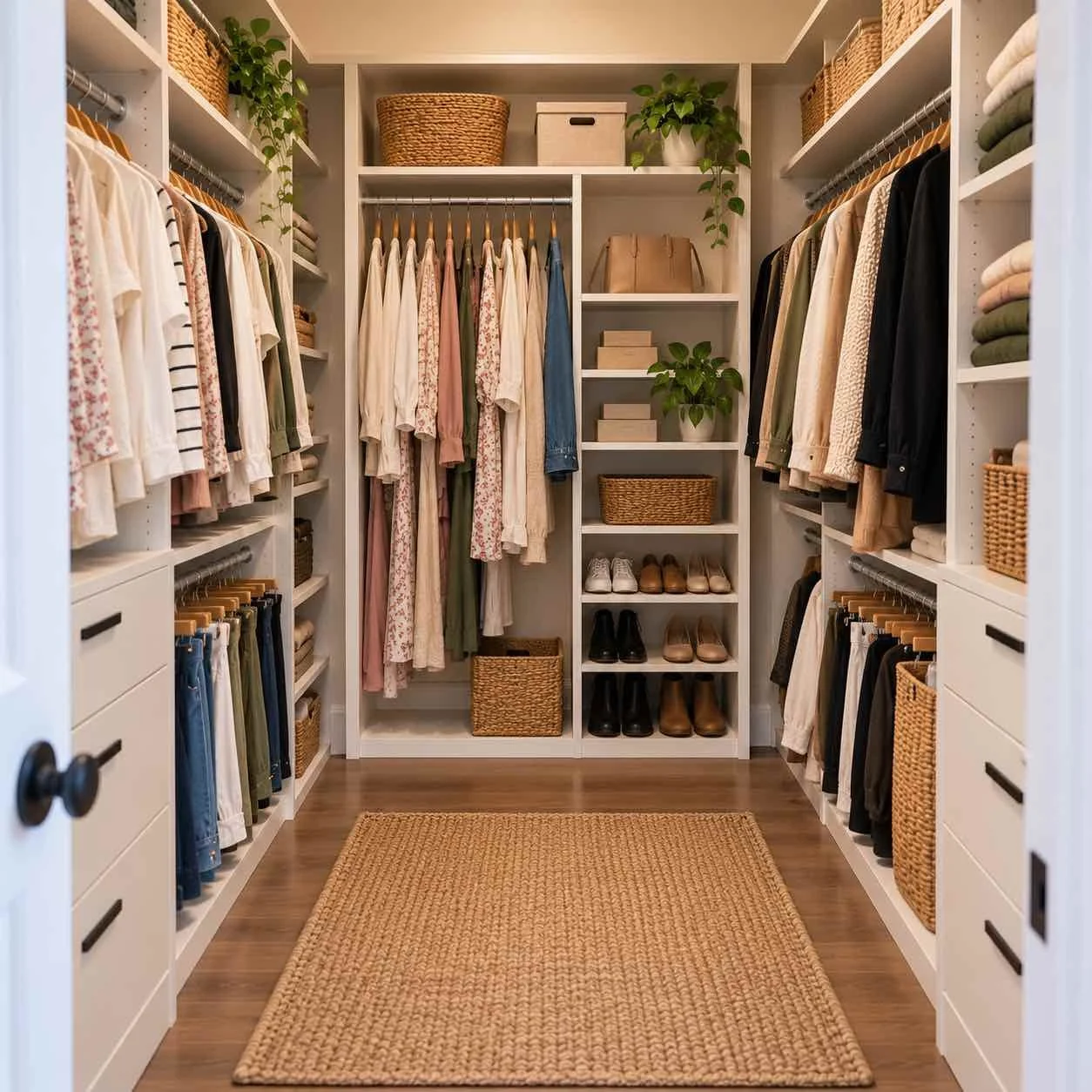
Many small walk in closet ideas suggest adding drawers, carts, shelving units or hampers, but each piece takes away the walking space that makes a walk-in useful. Protect your floor access, your ability to turn around and your ability to reach clothing without moving something first. If you cannot move comfortably, take one piece out before adding another. For any fixed shelving or installed changes, confirm that the installation and support are appropriate, and check your lease if you rent.
15. Fix the Most Frustrating Closet Problem First
If the whole closet feels like too much, start with one question:
What falls down most often?
What is hardest to reach?
What category constantly overflows?
What do I move every time I need something?
What do I forget I own?
What takes up prime space but is rarely used?
Solving one clear problem is usually more useful than redesigning the whole closet, and a small fix is easier to keep up.
Small Closet Organization Ideas for Different Closet Types
Many small closet ideas work in any closet, but the shape of the space changes which ones matter most.
Small Reach-In Closet
A reach-in has a limited opening, so visibility is the priority. Keep the center accessible, avoid stacking items front to back so deep that you cannot see the back, and protect the floor from crowding. Frequent items go toward the front, and occasional pieces go on upper shelves. If you are looking for reach-in closet ideas that cost nothing, start by clearing the floor and removing empty hangers.
Small Walk-In Closet
In a small walk-in, circulation comes first. Use the walls, but do not fill the center with furniture or carts. Place everyday clothing where it is easiest to reach as you step in, and keep occasional or seasonal items on the far or higher areas. The test is simple: can you walk in, turn around and reach what you need? If not, the closet is asking for fewer pieces, not more. Walk-in closet ideas that keep the middle open tend to stay useful longer.
Small Bedroom Closet
A small bedroom closet often carries more than clothing: extra bedding, luggage, gift wrap, boxes, sports gear. Decide what genuinely belongs inside, and where practical, move non-clothing items elsewhere. Our guide to small bedroom storage ideas covers options for items that may work better outside the closet. Small bedroom closet ideas get much simpler once the closet has only the things you use there.
Tiny Closet
In a very small closet, the answer may be reducing how many categories live there instead of finding a storage product for every category. Tiny closet ideas often come down to moving a few things out: seasonal clothing, rarely used bags, backup linens or extra household storage. Once the closet holds only what you use regularly, the clothes that stay are easier to reach and easier to see.
Small Closet Organization Without Buying Anything
Small closet organization often improves by changing what gets prime space, not by adding new storage. These no-buy ideas use only what you already have:
Remove empty hangers.
Group clothing by how you use it.
Move seasonal clothing higher or farther back.
Clear the closet floor.
Return shoes to one defined area.
Relocate unrelated household items.
Fold or re-stack items already on shelves so the front row is visible.
Move occasional clothing farther back.
Use existing boxes or containers before buying anything.
Remove empty packaging.
Stop storing items in the closet just because there is an empty shelf.
The last one matters more than it looks. An empty shelf is not always an invitation to fill it, and leaving some room helps the rest of the closet keep working.

Small Closet Storage Ideas That Do Not Overcrowd the Space
Good small closet design ideas are less about adding features and more about a few principles you can apply to any closet:
Use existing shelves fully before adding anything new.
Do not fill every vertical surface. Walls, doors and corners do not all need storage.
Add storage only where it solves a clear problem, such as a pile that keeps falling over.
Keep frequently used items visible so you do not have to move things to find them.
Protect access to rods and shelves. If you have to move one thing to reach another, something is in the wrong place.
Avoid large organizers in narrow walking areas.
Leave some space for the closet to function.
More storage capacity does not always mean easier access. A closet with more containers can still be harder to use if they block the way or hide what is inside.
How to Organize a Small Closet Step by Step
This sequence works for most closets and can be done in a few short sessions instead of one long one.
Remove items that clearly do not belong in the closet.
Group clothing and accessories by category.
Separate everyday items from occasional and seasonal items.
Clear the floor.
Put everyday clothing in the prime areas.
Assign shoes one location.
Assign bags and accessories one location.
Move seasonal items to secondary storage.
Reset shelves according to how often you use what is on them.
Check that everything is visible and reachable.
Use the system for a while before adding any new organizer.
That last step is the one most often skipped. After using the new arrangement in your normal routine, you will have a better sense of whether you actually need more storage or whether the changes were enough.
What Makes a Small Closet Harder to Use?
If your closet feels frustrating, one or more of these may be the cause. None of them is unusual; these problems can develop gradually as clothing, shoes and other items accumulate.
Everyday items stored too high or too far back
Seasonal clothing taking up prime space
A floor covered with shoes or bags
Too many unused hangers
Clothing packed so tightly it is hard to see or move
Shelves with several rows of unrelated items
Dirty and clean clothing mixing together
Accessories scattered in different places
Household items stored in the closet by default
Storage pieces that block access to rods or shelves
Usually only two or three of these apply. Fixing those first tends to make the biggest difference.
A Simple Closet Reset
Once the closet works, a short routine keeps it that way. It takes a few minutes:
Return shoes to their zone.
Hang or fold clothing.
Move dirty laundry to its place.
Return bags to their spot.
Clear the floor.
Remove empty hangers.
Reset the frequently used shelves.
Repeat the reset whenever the closet starts to feel crowded or items begin drifting out of their assigned areas.
A Small Closet Works Better When Prime Space Goes to Everyday Items
A small closet works better when accessibility comes before appearance. The things you use most deserve the easiest access, seasonal and occasional items can move farther away, and the floor is worth keeping usable. Visibility matters too: if you can see what you own, you are more likely to use it.
Storage is most helpful when it solves a specific problem, and not every shelf or wall needs to be filled. The closet does not need to look perfect to work well. If you would like more practical ideas for the rest of your home, you can explore more organization guides here on Lulonta.
