
A narrow hallway is first and foremost a passage, so anything you place there competes with the people walking through it. That is what makes decorating a hallway different from decorating a bedroom or living room. The goal is not to fill the empty walls or squeeze a piece of furniture into every available spot.
The best narrow hallway ideas usually come from keeping the floor path clear, using the walls deliberately, improving the lighting, creating some visual continuity and limiting competing focal points. This guide covers lighting, color, artwork, runners, mirrors, storage and long hallway layouts, and most of it can be done with changes to layout, light and things you already own.
Start With the Hallway’s Main Job: Getting You From One Room to Another
Before you change anything, spend a few minutes just walking the hallway the way you normally do. Circulation comes first, and decor should work around movement rather than interfere with it.
As you walk, notice a few things:
Where people enter and exit. Most hallways have a main route, and that route should stay open.
Which doors open into the hallway. A door that swings into the passage needs space to open fully, and that space is easy to forget until something blocks it.
Where the tightest points are. Corners, door frames and spots where two routes meet often feel narrower than the rest of the hall.
What limits your walls. Radiators, vents, light switches, thermostats and architectural details all affect where art, lighting or anything else can go.
How much natural light you have. Some hallways borrow light from a window at one end or from open doorways. Others get almost none.
What already projects into the path. A basket, a small table or a tall plant can narrow a hallway more than it seems when you’re used to it.
Every hallway is different. Ceiling height, flooring, length, door placement and rental restrictions all shape what will work, so treat the ideas below as options to test rather than rules.
17 Narrow Hallway Ideas for a More Open, Intentional Space
1. Keep the Floor Path as Clear as Possible
Narrow hallways usually benefit from less floor furniture. Small tables, baskets, plant stands, shoe racks and stools all look reasonable on their own, but in a passage even an attractive item becomes annoying when people have to step around it, turn sideways or avoid knocking it with a bag.
Keeping the floor clear can also make the hallway feel less visually crowded by reducing interruptions along the walking path. If your hallway does have enough room for a piece of furniture, a shallow one may work. Let circulation decide: if you or anyone in your home has to adjust their walking path to get past it, it is probably taking more space than the hallway can spare.
2. Create One Strong Visual Direction
Repeated visual interruptions can make a narrow hallway feel fragmented. A different color at each door, frames in several sizes and finishes, a mix of light fixtures and a few unrelated objects all ask the eye to stop and start again.
Continuity helps the eye travel through the space. You can create it with one consistent wall color, a repeated frame style, a runner that runs the length of the hall, doors painted in related colors or lighting that repeats at a steady rhythm. You only need one or two of these. Nothing has to match exactly. The aim is a sense that the hallway was planned as a single space, not assembled one object at a time.
3. Use Color to Connect the Hallway
Pale walls can reflect more of the available light, which is helpful in a hallway with few windows. But light paint is not the only way to make a hallway work. A mid-tone can feel calm and grounded, and a deep color can make a narrow passage feel deliberate and cozy, especially when the walls, trim and doors are handled consistently.
White does not automatically make a small hallway feel bigger. A stark white hallway with poor lighting can still feel flat and enclosed, while a dark hallway with good lighting can feel intentional.
Continuity with the rooms around it can matter more than choosing the lightest possible shade. If the hallway opens onto a living room or bedroom, a color that relates to those spaces, even if it is deeper or softer, can make the whole home feel more connected. The same thinking applies in compact living spaces, as in Lulonta’s small living room ideas.
4. Give a Long Hallway a Destination
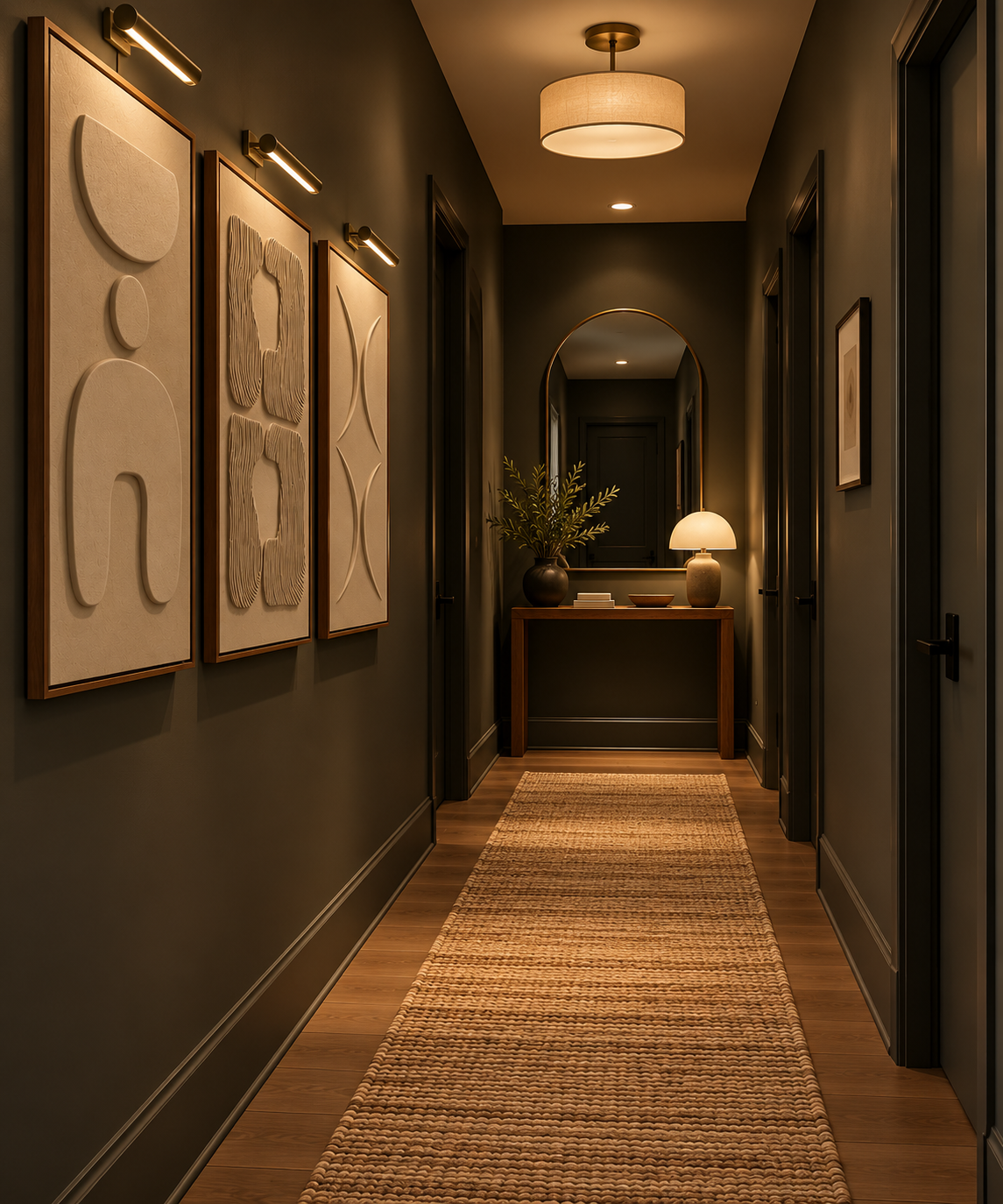
Long narrow hallway ideas often start with the end of the hall. A long, narrow passage can feel tunnel-like when the eye has nothing to land on. Giving the far end a subtle focal point changes how the space reads.
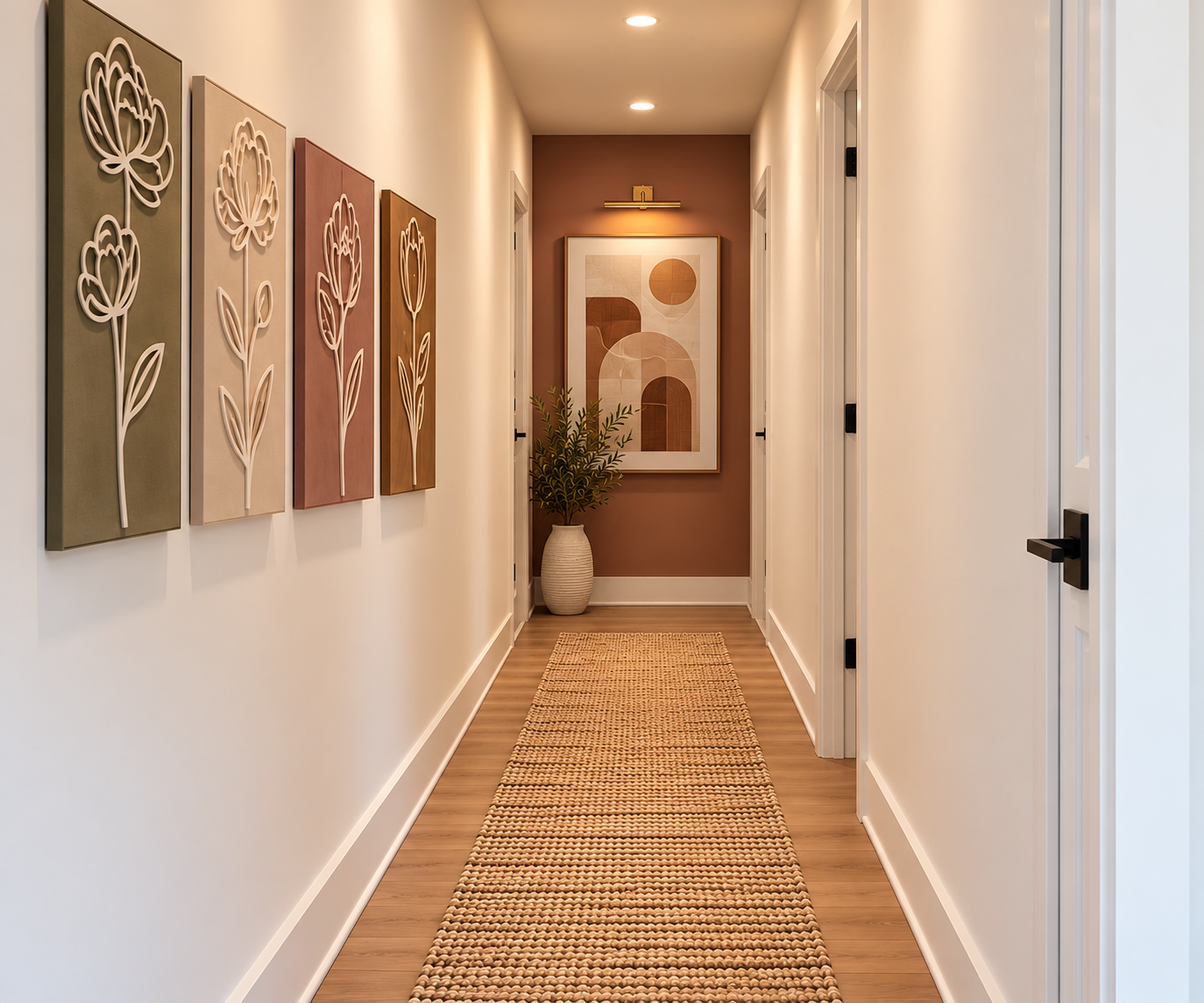
That endpoint can be an artwork, a block of color on the end wall, a doorway with a view into a lit room, a mirror that reflects something worth seeing or a framed view into another space. It does not need to be elaborate. A single piece of art at eye level on the end wall can be enough to give the hallway a sense of direction.
If the end of the hallway doesn’t have room for furniture, don’t force it. A console table at the end of a very narrow hall may block the very route you are trying to improve. The wall itself can do the work.
5. Use Artwork in a Deliberate Rhythm
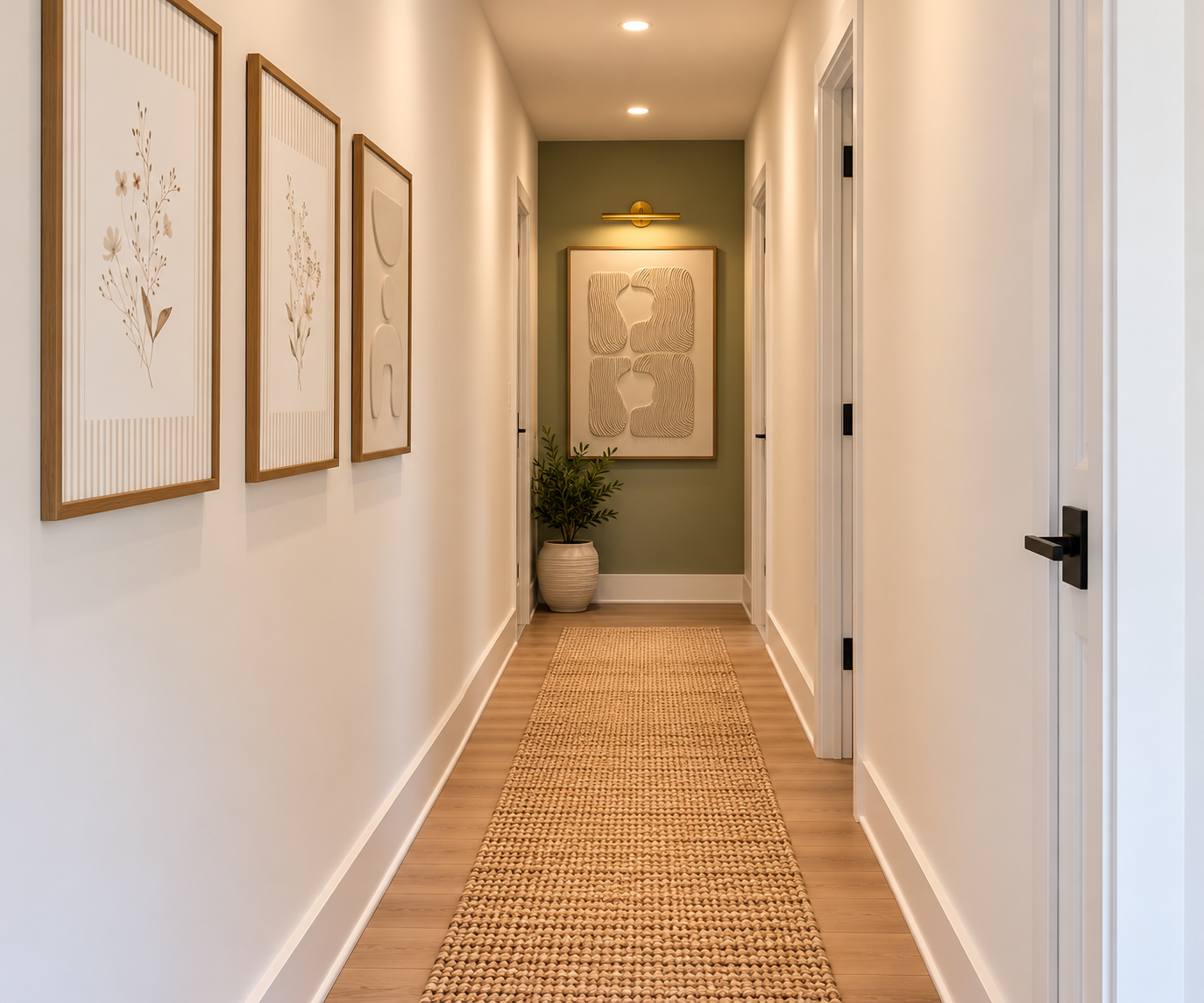
Walls are often the most flexible part of a narrow hallway, but too many unrelated small frames can make a tight space feel visually busy. A few approaches tend to work better in a passage:
One larger piece that gives the wall a clear focal point.
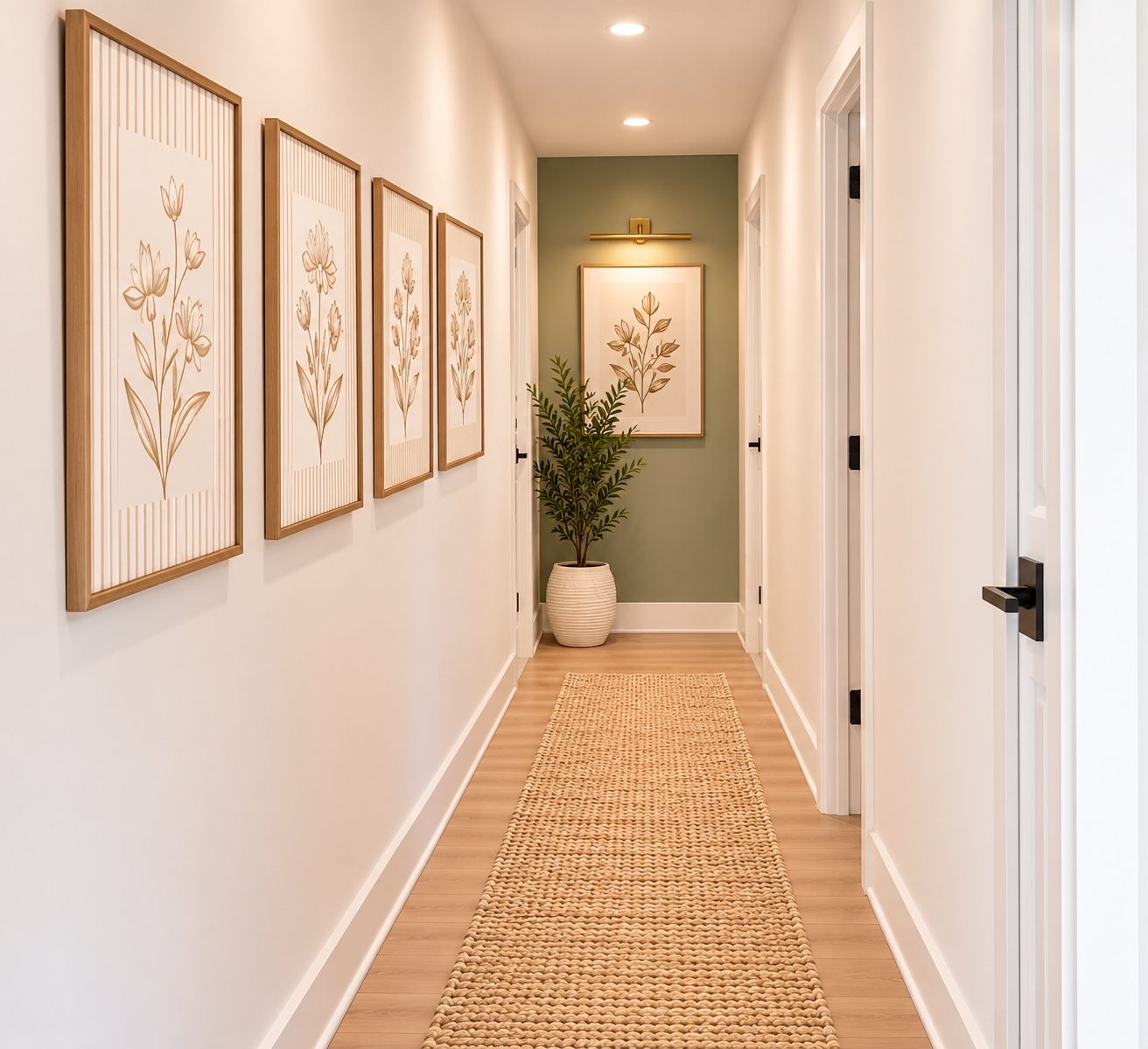
A consistent row of frames at a similar height, with similar spacing, which gives the eye something to follow along the length of the hall.
A restrained gallery wall with a limited palette or frame style, kept to one wall rather than both.
Spacing matters more than precision. Frames that sit too close together can look cluttered, while frames spread too far apart can look accidental. Aim for gaps that feel even and consistent, and hang everything at a height that works for people walking past, not only standing still.
If you’re planning a photo display, Lulonta’s photo wall ideas are bedroom-focused, but the arrangement approaches can be useful inspiration for hallway walls too. Just keep the scale more restrained in a narrow space.
6. Use Mirrors to Reflect Light or a Useful View
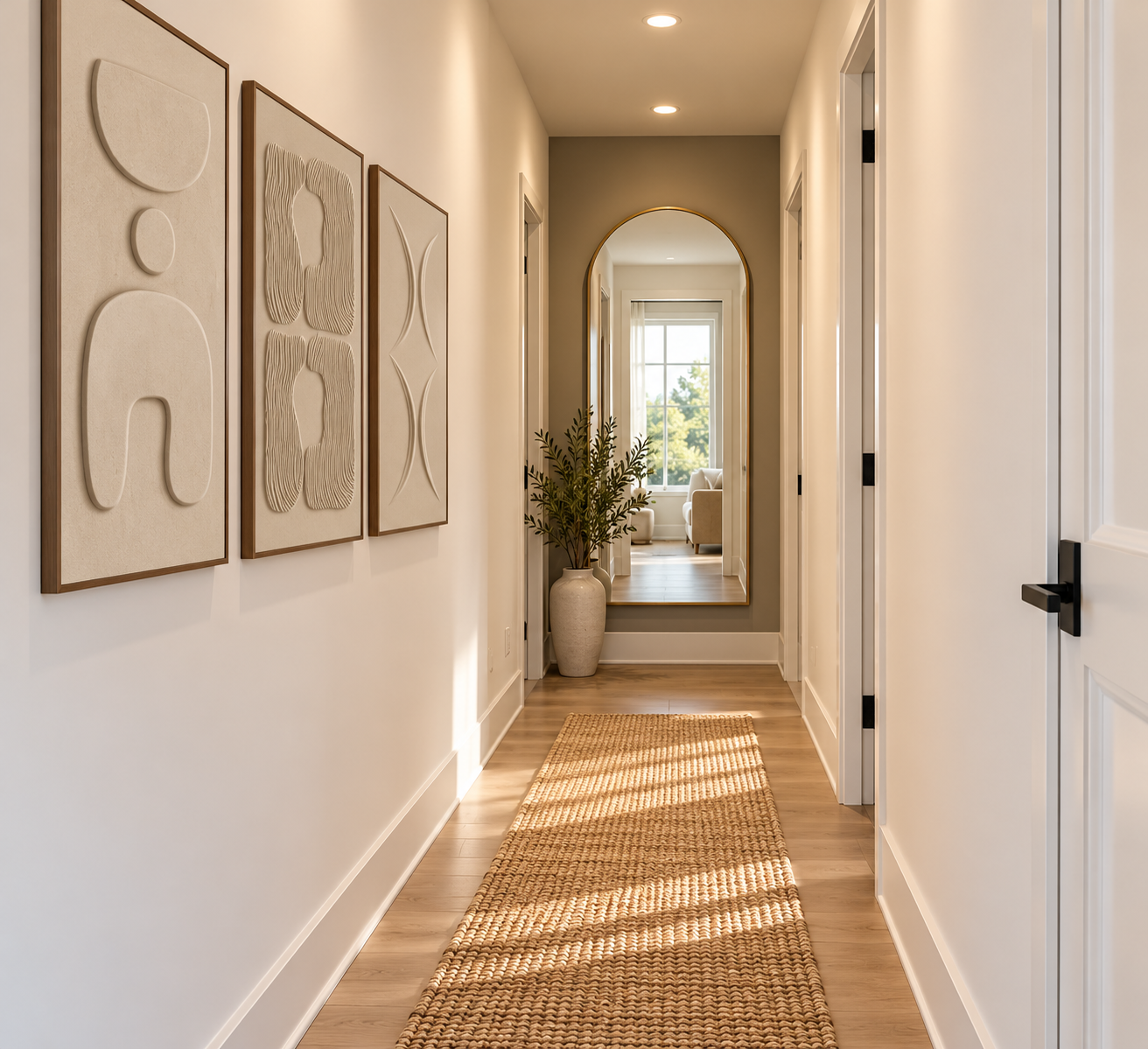
A mirror can reflect natural light, repeat a pleasant view and add a sense of depth. It does not physically enlarge the hallway, and placement matters more than the mirror itself.
Before hanging one, check what it would actually reflect. A mirror opposite a window or an open doorway into a bright room can bring light into a dim hallway. A mirror that reflects a blank door, a pile of items or an awkward corner may just repeat the thing you’d rather not see.
Mirrors can also add visual clutter if they compete with artwork, lighting and other wall features. In a hallway that is already decorated, one well-placed mirror usually does more than several. Try holding or leaning a mirror in different positions before committing to a spot.
7. Improve the Lighting Before Adding More Decor
Poor lighting can make a narrow hallway feel more enclosed than it is. If the hall is dim, adding decor will not fix the underlying issue, and extra objects may make it feel heavier.
Look at what you already have. Is the ceiling fixture providing enough light along the whole length? Are there dark sections in a long corridor? Can light from adjoining rooms spill in if you leave doors open? Does natural light reach the hallway at any time of day? Sometimes the simplest change is leaving a door open or adjusting what is blocking a window.
Wall lighting can help in some hallways, especially where a ceiling fixture leaves shadows, but it only makes sense if the walls have room and the fixtures won’t stick out into the walking path. If hardwired changes are needed, such as replacing a ceiling fixture or adding wall lights, appropriate professional installation may be necessary. Lighting that doesn’t require new wiring can be a simpler starting point, and it is worth confirming what your lease allows before changing any fixtures, and it is worth confirming what your lease allows before changing any fixtures.
8. Let Doorways Contribute to the Design
Hallways often have several doors, and they take up a lot of the wall. Rather than treating them as obstacles, you can let them contribute to the design.
Consistent door colors can create a calm rhythm along the hall, while an intentional contrast, such as painting doors a deeper shade than the walls, can make them a feature. Either approach works. Doors do not all need to match, but a loose relationship between them, in color or hardware finish, helps the corridor read as one space.
Also think about how open doors affect sightlines. When a door stays open, you see into the room beyond. If that room is tidy and bright, it can extend the feeling of the hallway. If it is cluttered, closing the door may be the better choice.
9. Consider Whether a Runner Helps the Space
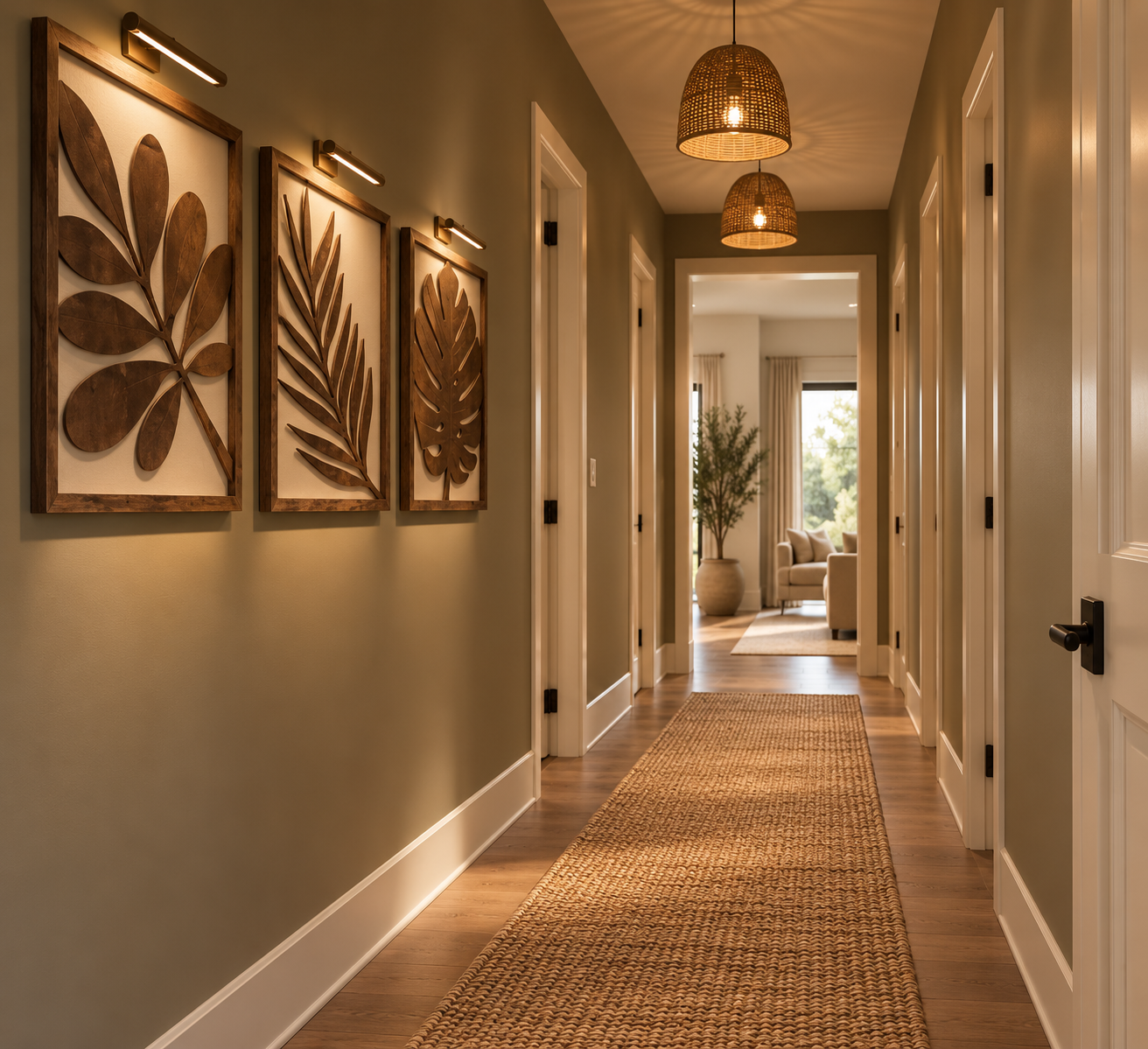
A runner can soften a hard floor, add color or pattern and emphasize the length of the hall. It can also give the passage a visual direction and make the space feel more connected from one end to the other.
It doesn’t always help. A runner can get in the way if doors catch on it, if the hallway is so narrow that the rug leaves almost no bare floor on either side or if the edges tend to curl. If anyone in your household has trouble with mobility or uneven surfaces, a loose runner may be an inconvenience, and in some homes bare flooring may simply be the better choice. A floor that already has strong color, pattern or grain can also look busy with a runner on top.
If you do use one, keep safety in mind in general terms: the runner should lie flat, stay put and not create a tripping hazard at the edges or near doorways.

10. Use Pattern Carefully
A narrow hallway can handle pattern, whether on a runner, wallpaper, a painted detail or artwork. Bold design is not wrong in a small space, and a patterned hallway can feel memorable and intentional.
The risk comes from several patterns competing at once. A patterned runner, patterned wallpaper and a busy gallery wall in the same short passage can make the space feel crowded. It usually helps to choose one main patterned element and let everything else stay calmer. If the runner is bold, keep the walls simple. If the wallpaper is the star, consider fewer frames.
11. Use Vertical Space for Decoration, Not Automatic Storage
Narrow hallways often have more wall area than floor area, so it is tempting to turn the walls into storage. But in a genuinely narrow corridor, anything that projects from the wall can make circulation worse.
Vertical space is often better suited to art, photos, wall lighting where it is suitable and, if circulation permits, shallow ledges. Even a shallow ledge can catch a shoulder or a bag, so it is worth testing the walking path before committing. The question to ask is not “what else can I put on this wall?” but “does anything on this wall change how comfortably people move past it?”
12. Keep Narrow Hallway Storage Ideas Problem-Specific
Storage belongs in a hallway only when there is a real need and enough clearance. Typical needs include linens near bedrooms, a few books, occasional household items or small family essentials that have no better home.
If the hallway is wide enough, a shallow piece or an existing built-in may be a reasonable fit. If it isn’t, consider alternatives: storage in adjoining rooms, a closet or cabinet already in the hall, a recessed area that is already part of the architecture or a few hooks placed only where they won’t obstruct movement.
Don’t add storage just because the wall is empty. The hallway can still feel finished without it. And if what you’re really trying to organize are shoes, keys and bags at the front door, that is an entryway problem, not a hallway one. In that case, Lulonta’s very small entryway ideas are more relevant.
13. Avoid Decorating Every Wall
Leaving some blank wall space can give a narrow hallway visual breathing room. A corridor with art on both sides, several mirrors, shelves, hooks and multiple colors can become visually dense, even if each item looks good alone.
When it suits the hallway, choose one dominant wall or one focal area, and let the opposite wall stay quieter. That doesn’t mean personal style has to disappear. A single, well-chosen piece often feels more personal than a wall filled out of habit, and the empty wall gives the decorated one room to stand out.
14. Repeat a Small Number of Materials or Finishes
Visual cohesion can make a corridor feel intentional rather than like a collection of leftovers. You can create it by repeating a few things: similar frame finishes, a recurring wood tone, one metal finish across fixtures and hardware or an accent color that appears more than once.
Nothing has to match perfectly. A few echoes are enough. When the same finish or color appears in a couple of places along the hall, the eye connects them, and the space feels more considered without adding any extra items.
15. Keep the Transition Into Adjacent Rooms in Mind
A hallway is experienced together with the rooms around it. When doors are open, you see through the hallway into whatever is next, so the connection between spaces matters.
Think about sightlines through open doorways, related colors between the hall and nearby rooms, how flooring changes at thresholds and whether a material or piece of artwork repeats from one space to the next. Also notice what sits right at room entrances. Bulky items near a doorway can make the hallway feel more cramped, even if the hall itself is clear.
The hallway does not have to match every room. A little connection, such as a shared color or finish, is usually enough to make the home feel more coherent.
16. Use the End Wall More Than the Side Walls When Space Is Very Tight
In an extremely narrow hallway, the end wall may be the safest place for visual interest, because it does not project into the walking path. A piece of artwork, a painted wall, a mirror or another decorative feature there can give the hall a focal point without touching the passage.
This is especially useful when side walls need to stay almost bare for circulation. Skip furniture at the end unless the hallway truly has room for it. A focal point on the wall can do much of the same work without costing any floor space.
17. Remove One Competing Element Before Adding Another
The last idea is about editing. If your hallway already has a runner, a gallery wall, bold paint, several doors and decorative lighting, it may not need another focal element. Often a hallway feels cramped because it has too many things asking for attention, not too few.
Try removing or temporarily relocating one thing and see whether the hallway becomes clearer. Take down a set of frames, roll up the runner or move a mirror to another room for a few days. Improvement does not necessarily require buying anything, and sometimes the simplest change is taking one thing away.
How to Make a Narrow Hallway Look Wider Without Remodeling
If you’re wondering how to make a narrow hallway look wider, the honest answer is that the hallway won’t physically change. What you can change is the feeling of crowding, and several small choices help with that:
Keep the walking path clear. An open floor is the most reliable way to make a passage feel less tight.
Improve the lighting. A well-lit hallway feels less enclosed than a dim one.
Reduce projections from the walls. Fewer shelves, hooks and protruding objects mean less visual and physical pressure.
Use visual continuity. Related colors, repeated finishes or a consistent rhythm of frames help the eye move smoothly.
Keep some wall space open. Blank areas give the decorated parts room to breathe.
Use mirrors carefully. A mirror reflecting light or a pleasant view can add depth, but one that reflects clutter won’t help.
Emphasize a destination at the end. A focal point draws the eye along the length of the hall.
Limit competing focal points. One or two strong features usually read better than five.
Consider how flooring or a runner directs the eye. A runner can emphasize length, while a very busy floor may need to stay as it is.
None of this will dramatically enlarge the space, but together these choices can make a narrow hallway feel calmer and less crowded.
Narrow Hallway Decorating Ideas for Different Situations
Narrow hallway decorating ideas work best when they match the hallway you actually have. Here are a few common situations.
A Long Narrow Hallway
A long hallway benefits from a clear endpoint, whether that’s artwork, a painted wall or a view into a bright room. Repeated elements, such as evenly spaced frames or lighting at a steady interval, can break up the monotony without crowding the walls.
If you use a runner, check that it suits the length and that it doesn’t interfere with doors along the way. In a long hall, a runner can emphasize the passage, but it needs to stay flat and secure for the whole run.
A Short Narrow Hallway
A short hallway often needs less than you think. Keep it simple: one focal element, such as a single piece of art, a mirror or a color choice, is usually enough. Avoid adding storage unless there’s a specific need, because in a short passage there isn’t much room for extras to disappear into. For a small, narrow hallway, restraint is often more useful than adding another decorative layer.
A Dark Hallway With Little Natural Light
Start with light sources. Check the ceiling fixture, see whether light from adjoining rooms can reach the hall and consider whether wall lighting suits the space (with professional installation if hardwiring is involved). Reflective surfaces, like a well-placed mirror, can help bounce light around.
Paint doesn’t have to be white. A pale color can brighten a dark hall, but a deeper shade with good lighting can feel warm and intentional. Open doors to adjoining rooms when you can, so light and sightlines extend into the hallway.
A Hallway With Lots of Doors
When doors dominate the walls, consistency or intentional contrast helps. Painting them in one color or a closely related range creates calm, while a deliberate contrast can turn them into a feature. Avoid decorating the small stretches of wall between every pair of doors, since that can look scattered. Instead, choose a few places for artwork or lighting and repeat them rhythmically, so the doors and the decor read as one pattern.
A Rental Hallway
In a rental, start with changes that can be undone. Artwork can lean on a ledge or sit in frames that use removable hanging methods, if your lease allows them. Lighting that plugs in or uses existing fixtures can help, as can a runner that stays flat. Check your lease before painting, drilling or changing fixtures, since some of these may be restricted.
For more ideas that work in rented homes, see Lulonta’s renter-friendly apartment ideas.
What Makes a Narrow Hallway Feel More Cramped?
If your hallway feels tight and you’re not sure why, one of these may be the cause. None of them is a mistake, just something worth noticing.
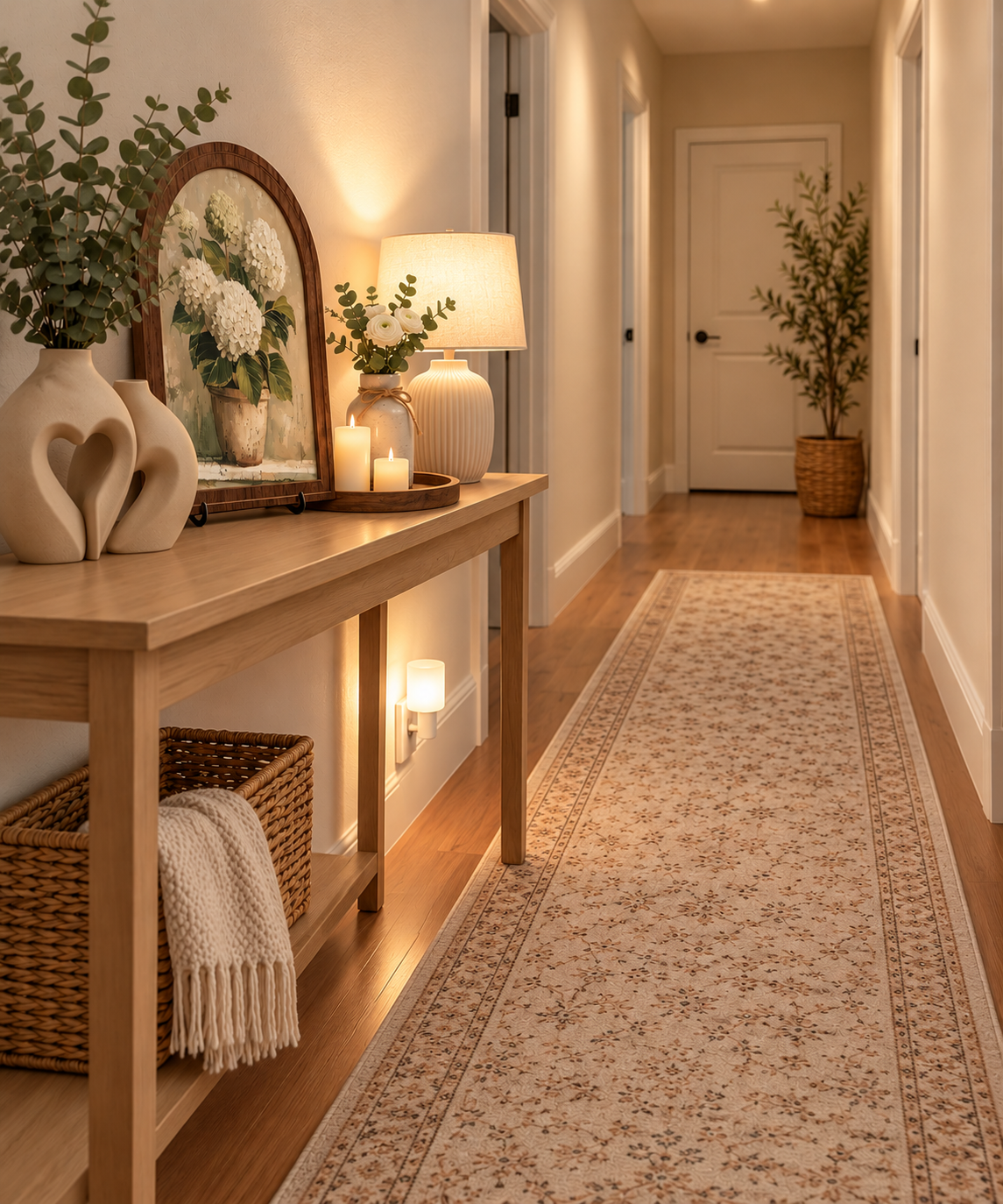
Furniture protruding into circulation. Even a small item can narrow the usable path.
Too many wall-mounted objects. Shelves, hooks and frames add up, especially on both sides.
Poor lighting. A dim hallway feels more enclosed.
Clutter on the floor. Bags, baskets and loose items interrupt the path.
Too many competing patterns. A bold runner, wallpaper and busy art can overwhelm the space together.
Several unrelated focal points. When everything stands out, nothing does.
Bulky items near doorways. They make transitions feel tight.
Runner placement that interferes with doors. If a door catches, the runner is working against you.
Storage added without enough clearance. It solves one problem and creates another.
Every wall being decorated. Without any quiet space, the hallway can feel dense.
Small Hallway Ideas You Can Try Without Buying Anything
Many small hallway ideas cost nothing. You can try a few of these in an afternoon:
Remove an unnecessary item from the hallway floor.
Relocate hallway clutter to a room that suits it better.
Rearrange existing artwork so the spacing and height are more consistent.
Edit a gallery wall by taking down a few pieces.
Open the doors to adjoining rooms to see how sightlines and light change.
Move a mirror to reflect a better source of light or view.
Clear the decor from one wall and see how the hallway feels.
Simplify what’s on display, keeping only what you like most.
Tidy visible cords, where that applies.
Reconsider whether your runner is helping or hurting the space.
None of these requires a purchase, and all of them can be reversed if you change your mind.
A Simple Narrow Hallway Reset
If you’d like a process to follow, this reset works in most hallways:
Remove everything sitting on the hallway floor that isn’t necessary.
Check which doors and routes need full clearance.
Take down wall decor temporarily.
Decide on one focal point or visual direction.
Improve the available lighting.
Reintroduce artwork or a runner selectively.
Stop before every wall is full.
Live with the simpler version for a few days before deciding whether anything is missing. A hallway often feels better than expected once it has been cleared, and you may find you need less than you thought.
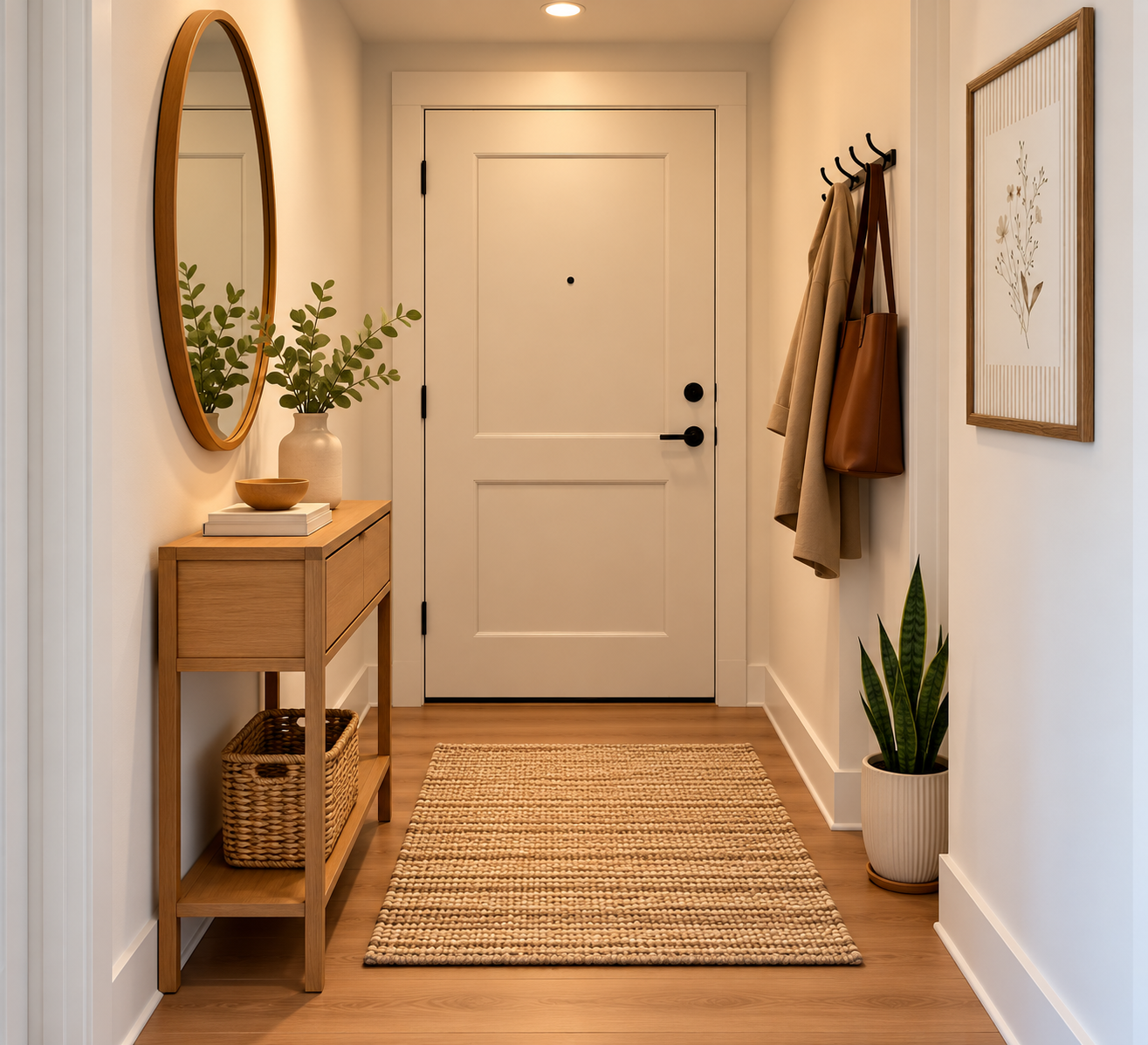
A Narrow Hallway Works Best When the Passage Stays the Priority
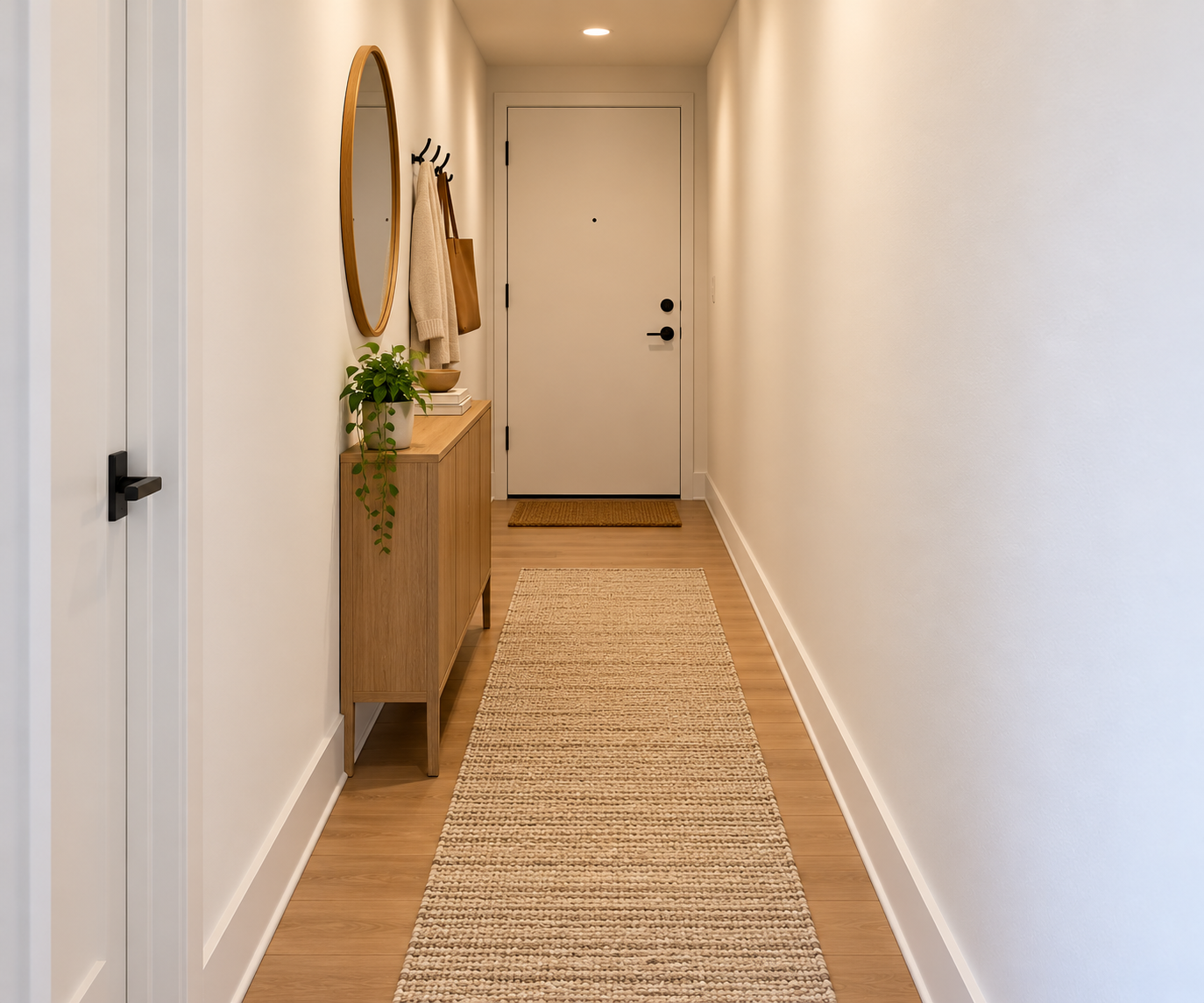
Circulation comes before decoration, and not every blank wall needs something on it. Lighting and visual continuity often do more for a narrow hallway than another piece of furniture, and personality can come from a few deliberate choices rather than many small ones. The best approach depends on your hallway’s length, light and door placement, so it is worth testing ideas before committing to them.
Improving a narrow hallway often means editing rather than adding. If you’d like more ideas for working with limited space, you’re welcome to explore Lulonta’s other small-space guides.
